Blog

Child Support Enforcement Brevard: Protecting Financial Responsibilities

When a parent stops paying child support, families face real financial hardship. Child support enforcement in Brevard County exists to hold parents accountable and protect your family’s stability.

At Billie Jo Hopwood Family Law & Mediation, PLLC, we help parents navigate enforcement options when payments fall behind. This guide walks you through Florida’s enforcement methods, the court process, and what to expect in Brevard County.

What Makes Child Support Enforceable in Florida

Florida’s Legal Framework for Support Obligations

Florida law treats child support as a legal obligation, not a suggestion. The state views support payments as a fundamental responsibility tied directly to a parent’s income and ability to pay. When Florida courts establish a child support order, they create a court order backed by enforcement mechanisms that can include wage withholding, license suspension, asset seizure, and even jail time for willful nonpayment. The Florida Department of Revenue administers child support through the State Disbursement Unit, which has processed payments since 1999 and now handles collection across all Florida counties. This centralized system means every payment gets tracked, documented, and distributed to the custodial parent through a standardized process.

How Florida Courts Calculate Support Amounts

Courts calculate support amounts using Florida’s guidelines, which consider both parents’ gross monthly income, the number of children, custody arrangements, and health insurance costs. The calculation isn’t arbitrary-judges must follow statutory formulas that produce specific percentages of combined parental income. Florida uses an income shares model, which divides the total support amount between parents in proportion to their incomes. For one child, the guideline is typically 20 percent of combined income; for two children, 25 percent; for three children, 30 percent. These amounts adjust based on factors like extended custody time, special needs, or significant income disparities.
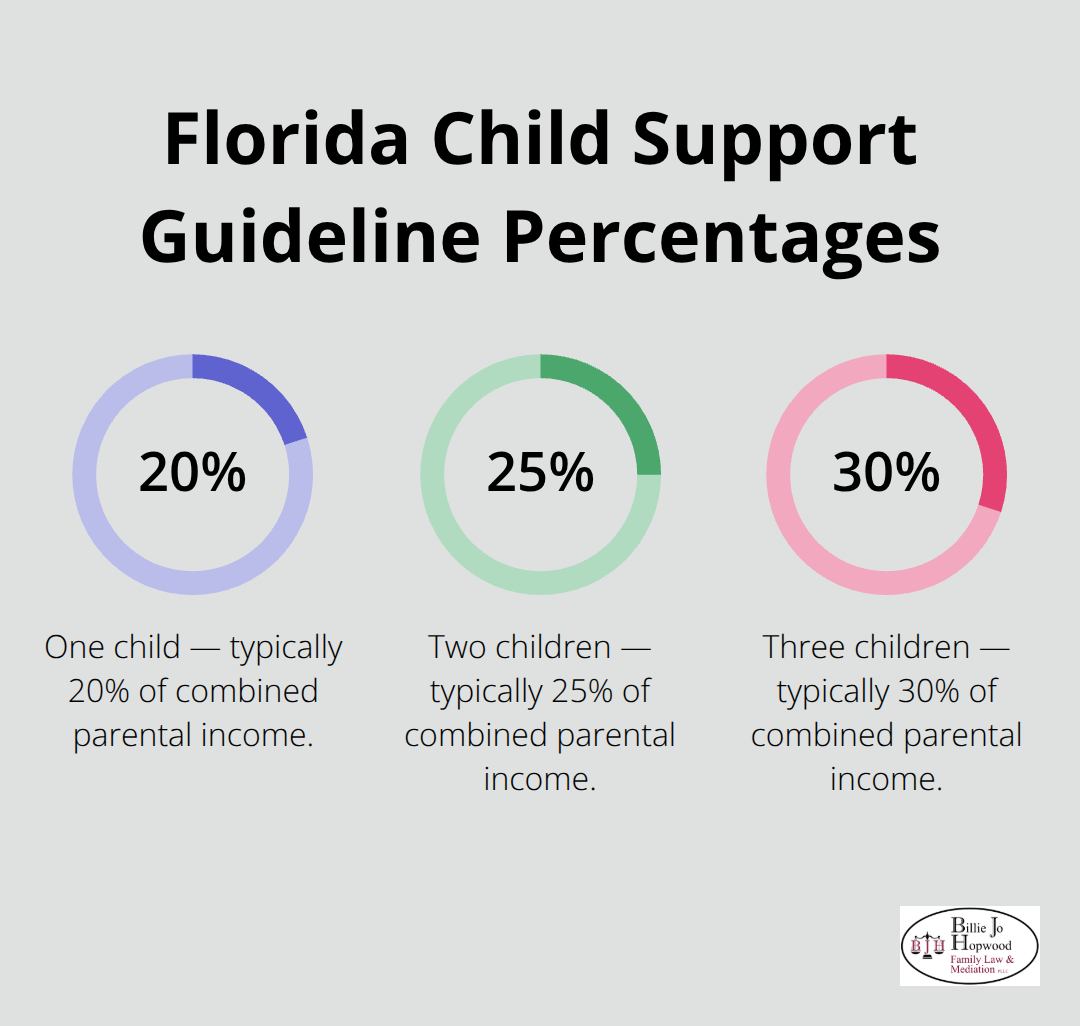
Chart showing guideline percentages of combined parental income by number of children in Florida - Child support enforcement Brevard

Distinguishing Between Hardship and Willful Nonpayment

Payments fall behind for various reasons, but Florida distinguishes between temporary hardship and willful nonpayment. A parent facing job loss or medical emergency might request modification, while a parent ignoring payment obligations faces enforcement action. The difference matters legally-courts can only impose jail time if they find the paying parent has the present ability to pay a specific dollar amount but refuses to do so.

Enforcement Actions That Take Effect Quickly

Once payments become delinquent, enforcement kicks in rapidly. After 15 days of nonpayment, the Clerk’s Office issues a Notice of Delinquency. If that debt remains unpaid for 20 days after the notice, a judgment enters against the nonpaying parent. This judgment can become a lien against property, vehicles, or boats.
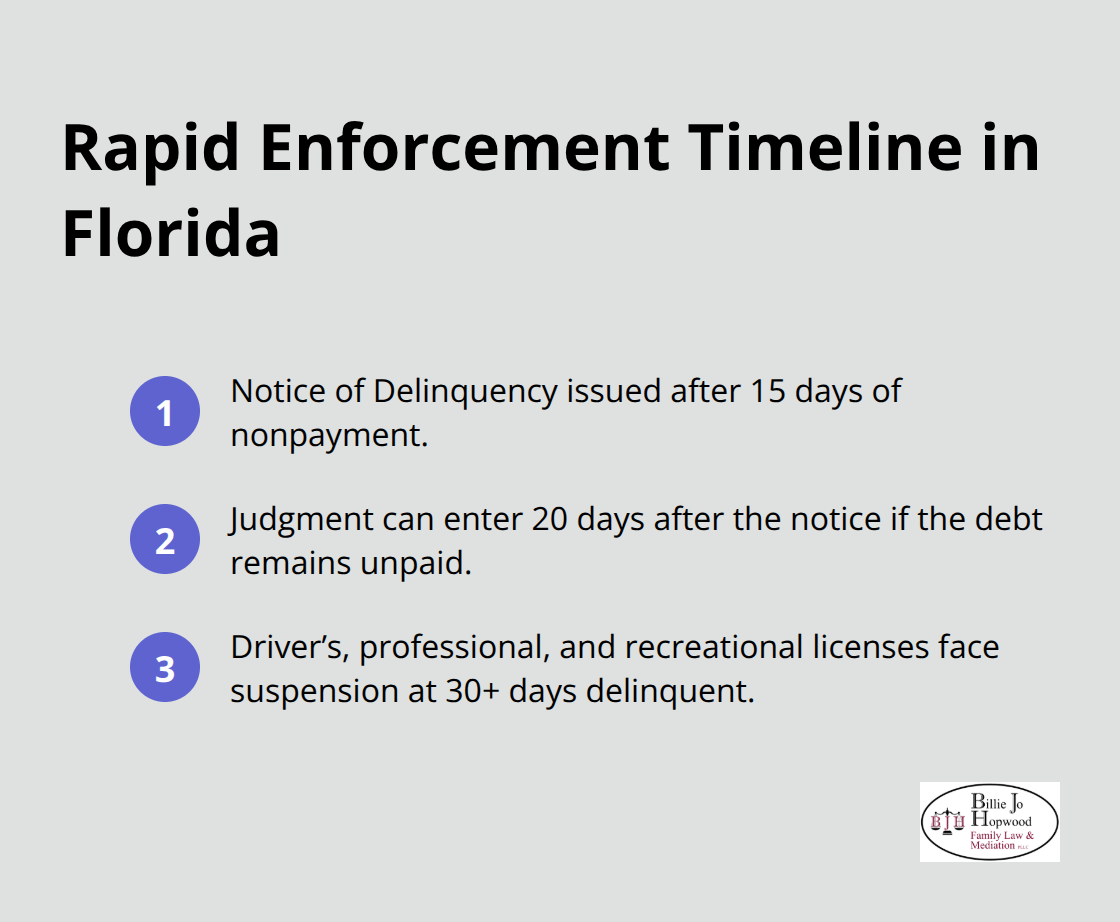
Ordered list showing 15-day notice, 20-day judgment, and 30+ day license suspension timeline for child support enforcement - Child support enforcement Brevard

The Florida Department of Revenue intercepts tax refunds, workers’ compensation benefits, insurance settlements, and other income sources to satisfy past-due amounts. Wage withholding stands as the most common enforcement tool-employers receive an Income Deduction Order and must deduct child support directly from the employee’s paycheck before other deductions. The program also reports delinquent accounts to credit bureaus, which damages the nonpaying parent’s credit score and financial standing. Driver’s licenses, professional licenses, and recreational licenses face suspension when support payments fall 30 days or more behind.

Why Florida’s Approach Works

These enforcement tools exist because Florida recognizes that families depending on child support cannot wait for slow legal processes. The state’s approach is aggressive by design-it removes excuses and creates immediate consequences for nonpayment. If you’re owed child support and payments have stopped, understanding these enforcement options helps you take action quickly. The next section walks you through how to file an enforcement action and what happens when you work with Brevard County courts.

How Enforcement Actions Stop Nonpayment

Income Withholding: The Most Effective Tool

Income withholding stands as the most effective enforcement tool Florida uses, and it works because it removes the paying parent’s ability to ignore obligations. When the Florida Department of Revenue files an Income Deduction Order, employers must deduct child support directly from paychecks before any other deductions take effect, except taxes. This means the money goes to the State Disbursement Unit automatically, with no opportunity for the paying parent to spend it elsewhere or claim hardship. Wage withholding catches roughly 75 percent of all child support cases statewide because it eliminates the decision to pay or not to pay. The process moves fast: once the order reaches an employer, deductions typically begin within one or two pay periods. If a paying parent switches jobs, the Florida Department of Revenue tracks the change through employment databases and sends a new deduction order to the new employer, so the withholding continues without interruption.

When Wage Withholding Doesn’t Apply

For self-employed parents or those earning cash income, wage withholding doesn’t apply, which is why Florida pursues additional enforcement methods simultaneously. The state combines multiple tools to close gaps that single enforcement actions cannot address. This layered approach increases the likelihood that past-due amounts get collected regardless of how a parent structures their income.

License Suspension and Asset Seizure

License suspension kicks in when payments fall 30 days behind, and this penalty creates real pressure because it affects daily life immediately. The Clerk’s Office can suspend a Florida driver’s license upon request from the custodial parent, which means the paying parent cannot legally drive. Professional licenses for contractors, nurses, real estate agents, and other occupations face the same suspension. Recreational licenses for hunting and fishing also get suspended. Simultaneously, the Florida Department of Revenue intercepts tax refunds, workers’ compensation settlements, insurance payouts, and unemployment benefits to satisfy past-due amounts. Bank accounts get levied when balances exceed a certain threshold, and liens attach to vehicles, boats, and real property.

Contempt of Court: The Serious Enforcement Path

Contempt of court proceedings represent the most serious enforcement action because they can result in jail time. When a paying parent misses payments and has the ability to pay, the court issues a notice and holds a contempt hearing. The paying parent must appear and explain the nonpayment. If the court finds the person had the ability to pay but willfully refused, incarceration follows until payment occurs or the court lifts the order. The key word is willful-temporary job loss or documented hardship provides a defense, but ignoring the obligation does not. Courts typically give paying parents 30 days to come into compliance before incarceration takes effect, though that timeline can shift based on circumstances.

What Happens When Enforcement Actions Begin

Once enforcement actions begin, the paying parent faces mounting pressure from multiple directions simultaneously. The combination of wage withholding, license suspension, asset seizure, and potential court action creates a comprehensive system designed to motivate payment. Understanding these enforcement mechanisms helps custodial parents recognize which tools apply to their situation and when to escalate their case. The next section explains how to file an enforcement action in Brevard County and what the court process actually looks like.

How to Start Enforcement in Brevard County

Filing Through the Clerk’s Office

The Clerk’s Office in the county where the original child support order was established handles enforcement filings. You have two paths: file through the Florida Department of Revenue or work directly with the Clerk’s Office to request enforcement. The Clerk’s Office issues a Notice of Delinquency after just 15 days of nonpayment, which triggers the formal process without requiring you to hire an attorney. If you choose to file independently, you submit paperwork that documents the missed payments, the original court order, and evidence of the nonpaying parent’s current employment or assets. Florida law mandates action within specific timeframes, so the Clerk’s Office processes these filings quickly. Once filed, a judgment typically enters within 20 days if the delinquent amount remains unpaid after the Notice of Delinquency, meaning the court process moves faster than most people expect.

Payment Agreements and Early Intervention

You can request a Payment Agreement online without calling or visiting an office, which gives the paying parent a chance to catch up before harsher enforcement kicks in. This early intervention often prevents escalation to wage withholding or license suspension, though it won’t stop if nonpayment continues. The option to negotiate repayment demonstrates that Florida’s system allows flexibility when parents show willingness to comply.

The Florida Department of Revenue’s Role

The Florida Department of Revenue handles enforcement statewide and maintains databases that track employment changes, asset ownership, and income sources across all employers in Florida and out-of-state locations. When you involve the Department of Revenue, they pursue income withholding immediately while simultaneously pursuing other collection methods. Their enforcement portal allows you to apply for enforcement actions and monitor case progress without constant phone calls.
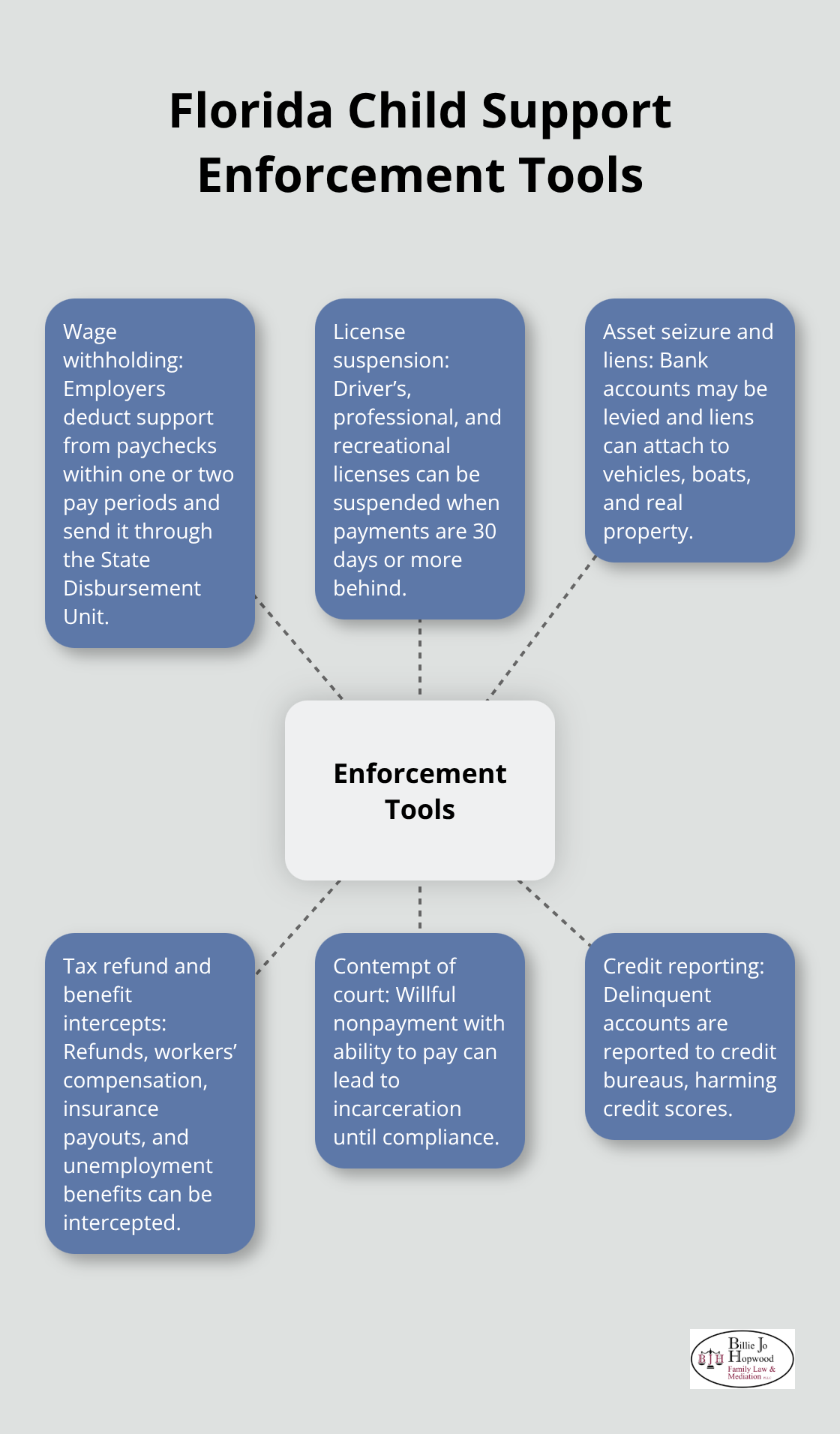
Hub-and-spoke diagram showing key Florida child support enforcement tools around a central concept

The Department intercepts tax refunds, workers’ compensation benefits, and unemployment payments automatically when someone owes past-due support.

Timeline and Court Hearings

Brevard County residents access the same enforcement tools as the rest of Florida, meaning your case receives the same systematic attention regardless of county location. The State Disbursement Unit processes all payments through a centralized system, so you can check payment status by calling 877-769-0251 or viewing the last three transactions online at myfloridacounty.com. The entire enforcement timeline spans several months from filing to resolution, though wage withholding typically begins within one to two pay periods once the order reaches an employer. Court hearings for contempt proceedings usually occur within 30 to 60 days of filing, depending on court availability. If the paying parent contests the enforcement action or claims inability to pay, the timeline extends because the court must hold a hearing to determine present ability to pay before imposing jail time.

Final Thoughts

Child support enforcement in Brevard County protects your family’s financial stability when payments stop. The tools available through Florida’s system-wage withholding, license suspension, asset seizure, and contempt proceedings-create a comprehensive framework designed to hold paying parents accountable. Understanding how these mechanisms work gives you confidence that the legal system takes nonpayment seriously and responds quickly.

You don’t have to chase down payments alone. The Florida Department of Revenue, the State Disbursement Unit, and your county Clerk’s Office handle enforcement systematically, and filing a Notice of Delinquency costs nothing while triggering action within days. Wage withholding begins within one or two pay periods once employers receive the Income Deduction Order, and tax refunds, workers’ compensation benefits, and other income sources get intercepted automatically.

Navigating enforcement successfully often requires guidance, as court procedures, documentation requirements, and strategic decisions about which enforcement tools to pursue first benefit from professional input. At Billie Jo Hopwood Family Law & Mediation, PLLC in Melbourne, Florida, we help families pursue child support enforcement when payments fall behind. Contact us to discuss your situation and explore your enforcement options.
Brevard Family Law Attorney: How Local Counsel Supports You

Family law matters in Brevard County demand more than generic legal advice. A Brevard family law attorney who understands local court systems, judges, and community dynamics can make a real difference in your case outcome.

We at Billie Jo Hopwood Family Law & Mediation, PLLC work with families throughout the area to navigate divorce, custody disputes, and support arrangements. This guide shows how local representation protects your interests and moves your case forward efficiently.

Why Local Counsel Makes the Difference in Brevard

Florida Family Law and Local Court Interpretation

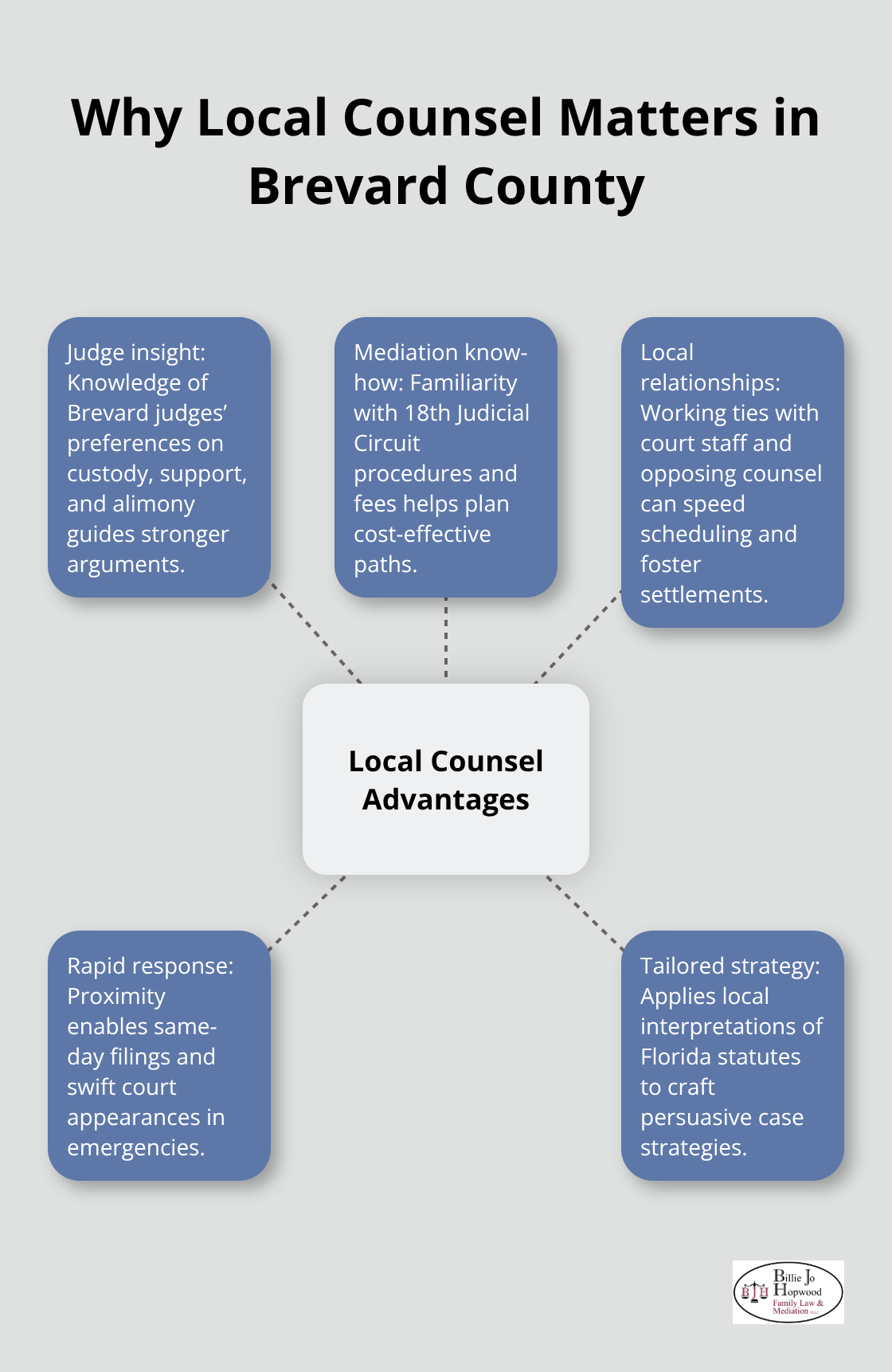
Florida family law operates under specific statutes that govern everything from property division to child support calculations. Florida Statutes section 61.075 sets child support guidelines based on combined parental income, but judges in Brevard County apply these rules with local discretion. An attorney familiar with how Brevard judges interpret and apply these guidelines-rather than someone working from a general understanding of Florida law-positions you to argue your case more effectively. Local counsel knows which judges prioritize shared parenting arrangements, which ones lean toward traditional custody models, and how they handle alimony disputes. This knowledge shapes strategy from the start.

Infographic showing key advantages of hiring a Brevard family law attorney with local experience.

The 18th Judicial Circuit and Mediation Procedures

The 18th Judicial Circuit, which serves Brevard and Seminole Counties, has specific mediation procedures and fee structures that differ from other Florida circuits. Court-ordered mediation in Brevard costs $60 per party per session if combined household income is under $50,000, and $120 per party per session for income between $50,000 and $100,000. An attorney who practices regularly in this circuit understands these costs upfront and can advise whether mediation makes financial sense for your situation. They also know the mediators available through the circuit and can often recommend someone whose approach fits your case.

Relationships That Accelerate Your Case

Local counsel has relationships with court staff, opposing attorneys, and judges that smooth the path forward. These connections matter when you need a hearing scheduled quickly, when procedural questions arise, or when settlement negotiations require someone the other side respects. An attorney with established standing in the local legal community can often move your case faster than an outsider unfamiliar with Brevard’s court culture.

Accessibility When Your Family Needs It Most

Accessibility in a family law matter directly affects your case outcome. When your custody arrangement falls apart or your ex stops paying support, you need to reach your attorney quickly, not wait for someone to return from across the state. Local representation means in-person meetings when they matter most. You can walk into an office, sit down with your attorney, and review documents together rather than coordinating calls across time zones.

For families dealing with domestic violence injunctions, relocation disputes, or urgent custody modifications, proximity proves invaluable. A local attorney can file emergency motions the same day a situation escalates and appear in court with minimal delay. The difference between same-day response and next-week response can determine whether you secure temporary custody, obtain protective relief, or protect your parental rights during a crisis. This responsiveness sets the foundation for how your case develops and what outcomes become possible.

How a Brevard Attorney Guides You Through Divorce

Divorce reshapes three major areas of your life: how assets split between you and your ex, who spends time with the children, and whether one spouse pays alimony to the other. A Brevard family law attorney translates Florida law into concrete numbers and strategies tied to your specific circumstances rather than generic formulas that ignore what actually happened in your marriage.

Child Support Calculations and Local Court Practice

Florida Statutes section 61.075 sets child support using a formula based on both parents’ incomes and the amount of time each parent spends with the child. The formula produces vastly different outcomes depending on how a judge calculates your income or classifies your parenting time. A local attorney challenges income calculations that underestimate what you actually earn and contests parenting time classifications that don’t reflect your real involvement with your children. Brevard judges apply these calculations with discretion, and an attorney familiar with how individual judges in this county interpret the guidelines positions you to argue for child support amounts that reflect your actual financial situation.

Property Division and Asset Protection

Property division follows Florida’s equitable distribution model, which means the court divides marital assets fairly but not necessarily equally. Retirement accounts accumulated during marriage, business interests, real estate equity, and investment portfolios all fall into this category. A local attorney identifies which assets qualify as marital property, which remain separate, and which merit special handling to minimize tax consequences when dividing them. The difference between treating a retirement account as a simple 50-50 split versus structuring a qualified domestic relations order (QDRO) can save thousands in taxes and penalties.

Alimony: Duration, Amount, and Negotiation Strategy

Florida courts consider eleven factors when awarding alimony, ranging from the length of the marriage to each spouse’s earning capacity and standard of living during the marriage. A marriage lasting less than seven years typically generates short-term alimony, while marriages exceeding seventeen years often trigger long-term or permanent support obligations. Judges in Brevard County apply these guidelines with discretion based on local practice and individual judge preferences. An attorney who regularly appears before these judges knows which judges emphasize earning capacity and self-sufficiency versus those who weigh the standard of living more heavily. This knowledge shapes settlement strategy from negotiation through trial. If your ex claims they cannot work due to caregiving responsibilities, a local attorney challenges that claim with evidence of earning potential or market demand for their skills. If you earned significantly more throughout the marriage, your attorney prepares you for an alimony award while negotiating duration and amount based on realistic outcomes in Brevard courts.

Custody Arrangements and Parental Time

Custody arrangements require demonstrating that your proposed parenting plan serves the child’s best interests under Florida law. The court considers factors like each parent’s involvement in the child’s life, the child’s relationship with siblings, and any history of substance abuse or domestic violence. A Brevard attorney presents this evidence in a format that resonates with local judges, avoiding generic arguments and instead anchoring your case to specific examples of your involvement in school decisions, medical care, and daily routines. The combination of protecting your financial interests while securing meaningful parental time demands coordination across property division, support calculations, and custody strategy-which is why local representation that understands how these elements interact in Brevard courts produces outcomes that serve your family’s actual needs.

When multiple issues intersect in your divorce, the decisions you make about one area affect outcomes in the others. The next section shows how mediation and conflict resolution can help you address these interconnected issues more efficiently than court proceedings alone.

How We Support Brevard Families Through Every Stage

Mediation as a Path to Settlement

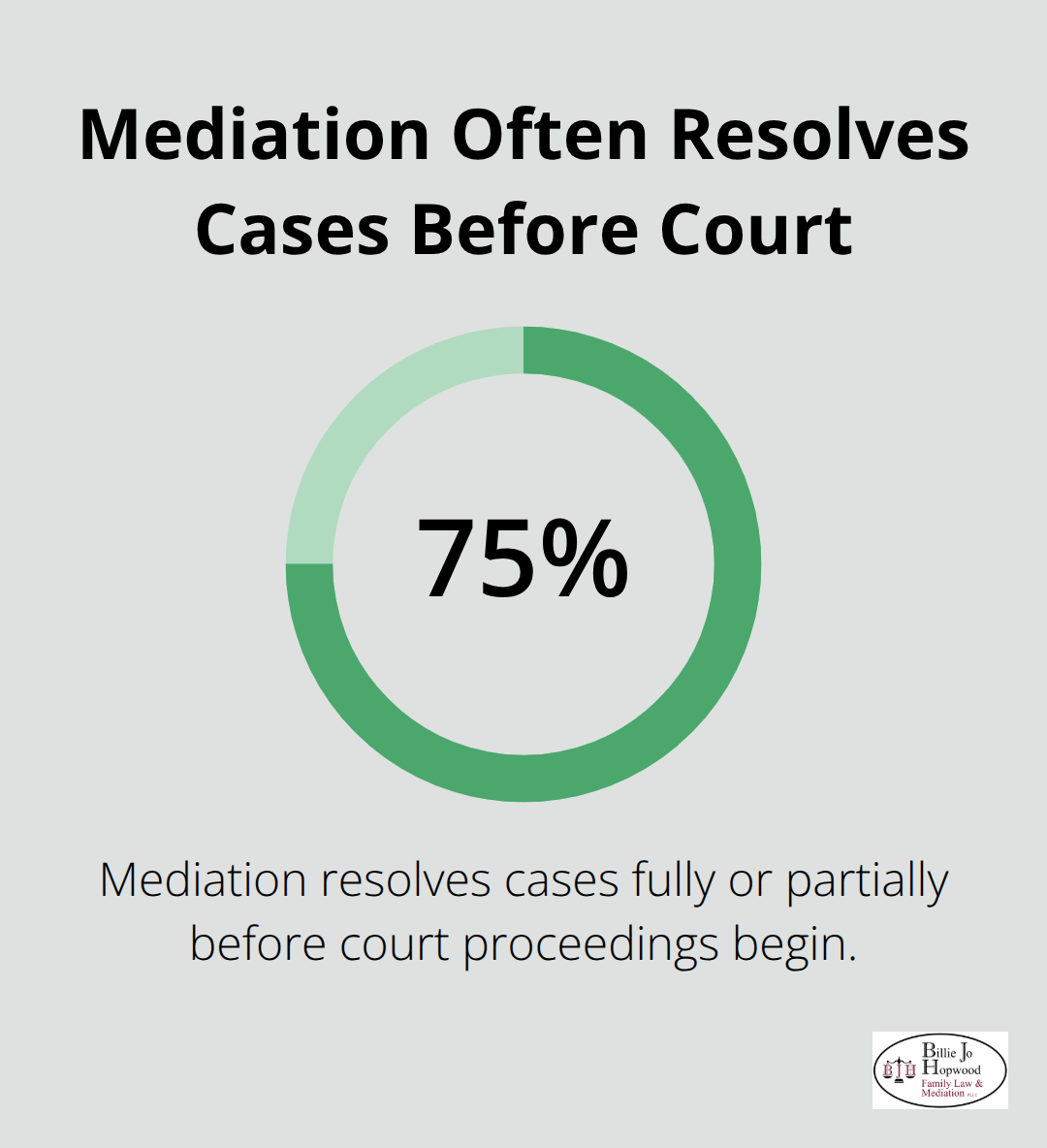
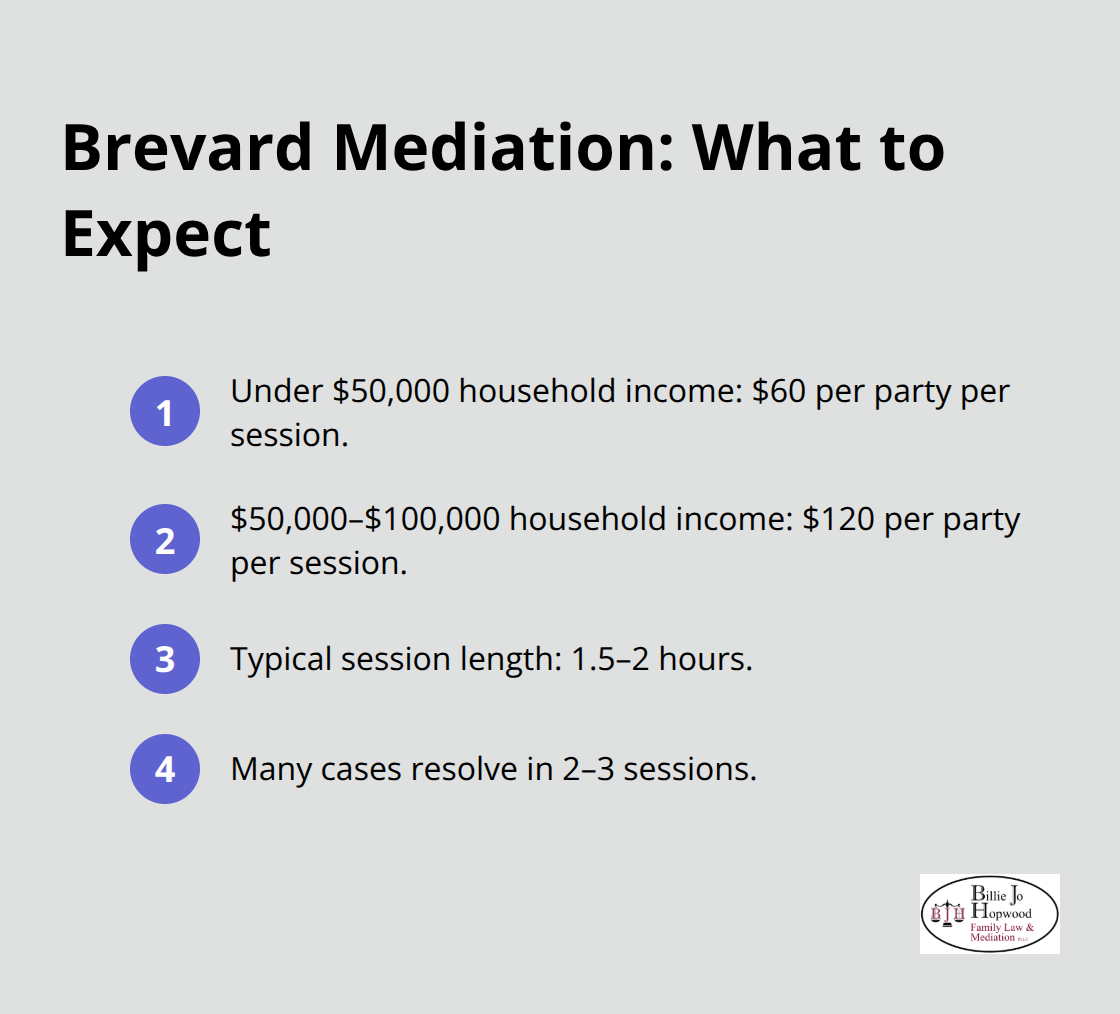
Mediation resolves disputes faster and costs significantly less than litigation. The 18th Judicial Circuit charges $60 per party per session for families with combined household income under $50,000, and $120 per party per session for income between $50,000 and $100,000. A single mediation session typically runs 1.5 to 2 hours, and many cases settle within two to three sessions rather than proceeding to trial.

Compact list of mediation fees and timelines in Florida’s 18th Judicial Circuit.

We at Billie Jo Hopwood Family Law & Mediation, PLLC prepare families for what mediators will ask, identify which issues are negotiable and which require firm positions, and translate settlement offers into language that protects your long-term interests. Mediation works best when both parties want to avoid court, but it also works when one spouse initially resists-a skilled mediator helps the reluctant party see financial and emotional advantages to settlement.

Confidentiality and Strategic Advantage in Mediation

The confidentiality of mediation matters significantly. Nothing said during mediation can be used against you in court if settlement fails, which means you can explore options without creating evidence that harms your case later. For custody disputes specifically, mediators help parents focus on what the child needs rather than what each parent wants, which shifts the conversation from winning to problem-solving.

If mediation stalls on specific issues like child support calculations or property division, an attorney can step in to provide legal analysis showing why your position aligns with Florida law and local court practice. This analysis gives the mediator and the other side concrete reasons to move toward your proposal.

Preparing for Court Representation

Court representation requires different preparation than mediation. You need evidence organized by issue, witness testimony lined up in logical sequence, and responses to objections your ex’s attorney will raise. Judges notice when witnesses fumble basic facts or contradict themselves, so clear testimony about your income, your involvement with your children, and the property you brought into the marriage matters significantly.

For custody hearings, present evidence showing your involvement in school decisions, medical appointments, and daily routines through emails, calendars, photos, and school records rather than general statements about being a good parent.

Child Support Modifications and Evidentiary Requirements

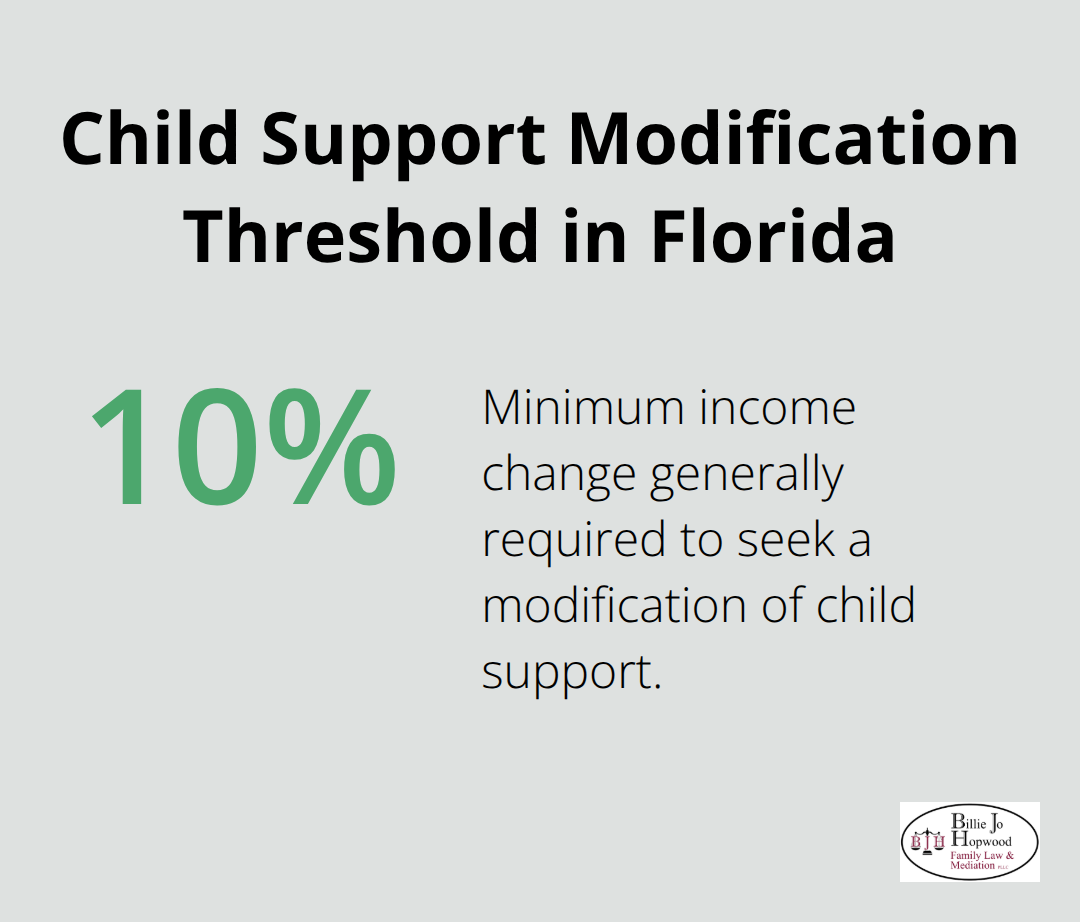
Child support modifications follow specific procedures under Florida Statutes section 61.071-you must show a substantial change in circumstances, typically a 10 percent or greater change in income, to justify adjusting support amounts. An attorney gathers tax returns, pay stubs, and employment records documenting that change and files modification petitions that cite the exact statute and local case precedent Brevard judges follow.

Percentage chart showing the income-change threshold to modify child support. - Brevard family law attorney

Alimony Modifications and Changed Circumstances

Alimony modifications require showing changed circumstances as well, whether that means your ex now earns significantly more, you face unexpected medical expenses, or the recipient has begun cohabiting with a new partner. The burden of proof differs depending on which party seeks modification, and an attorney builds the evidentiary record that meets that burden from the start rather than discovering gaps during trial.

Final Thoughts

Judges, court staff, and opposing counsel recognize a Brevard family law attorney who appears regularly in local courtrooms, which accelerates scheduling, smooths procedural questions, and creates pathways to settlement that outsiders cannot access. When your attorney knows the judge assigned to your case and understands their preferences on custody arrangements or property division, your arguments carry more weight from the opening statement forward. Quick response times separate local representation from distant counsel who must travel across the state or coordinate schedules across time zones.

Family law crises do not wait for attorneys to respond slowly. When your ex violates a custody order, stops paying child support, or threatens to relocate with your children, you need someone who can file emergency motions the same day and appear in court within hours if necessary. A Brevard family law attorney operates from your community, meaning urgent situations receive immediate attention rather than delayed responses that cost you time and parental rights. This responsiveness protects what matters most during the most difficult moments.

Understanding community and family dynamics matters more than generic legal knowledge (Brevard County families face specific circumstances shaped by local employment patterns, military connections, and relocation pressures that differ from other Florida regions). A local attorney recognizes when a parent’s job transfer genuinely requires relocation versus when it represents a pretext to distance a child from the other parent. We at Billie Jo Hopwood Family Law & Mediation, PLLC bring this local knowledge to every family law matter we handle in Melbourne and throughout Brevard County.

Fair child support mediation: What It Means for Your Family Law Journey

Child support disagreements often leave parents feeling stuck between expensive court battles and uncertainty about fair outcomes. Fair child support mediation offers a different path-one where both parents work together to reach agreements that actually work for their families.

At Billie Jo Hopwood Family Law & Mediation, PLLC, we’ve seen how mediation transforms these conversations from adversarial to collaborative. This guide walks you through what mediation looks like and why many Melbourne, Florida families choose it over litigation.

How Mediation Works vs. Court Litigation

The Judge Decides in Court, You Decide in Mediation

In court, a judge makes binding decisions about child support after reviewing evidence, financial documents, and arguments from both sides. You have limited control over the outcome, and the process follows rigid procedural rules that can stretch over months or even years. Litigation operates as an adversarial system-each parent’s attorney presents their case to convince the judge their client deserves a favorable ruling. The Florida Department of Revenue can automatically open a child support case and issue wage-withholding orders, which means the state moves forward with enforcement regardless of whether you want court involvement.

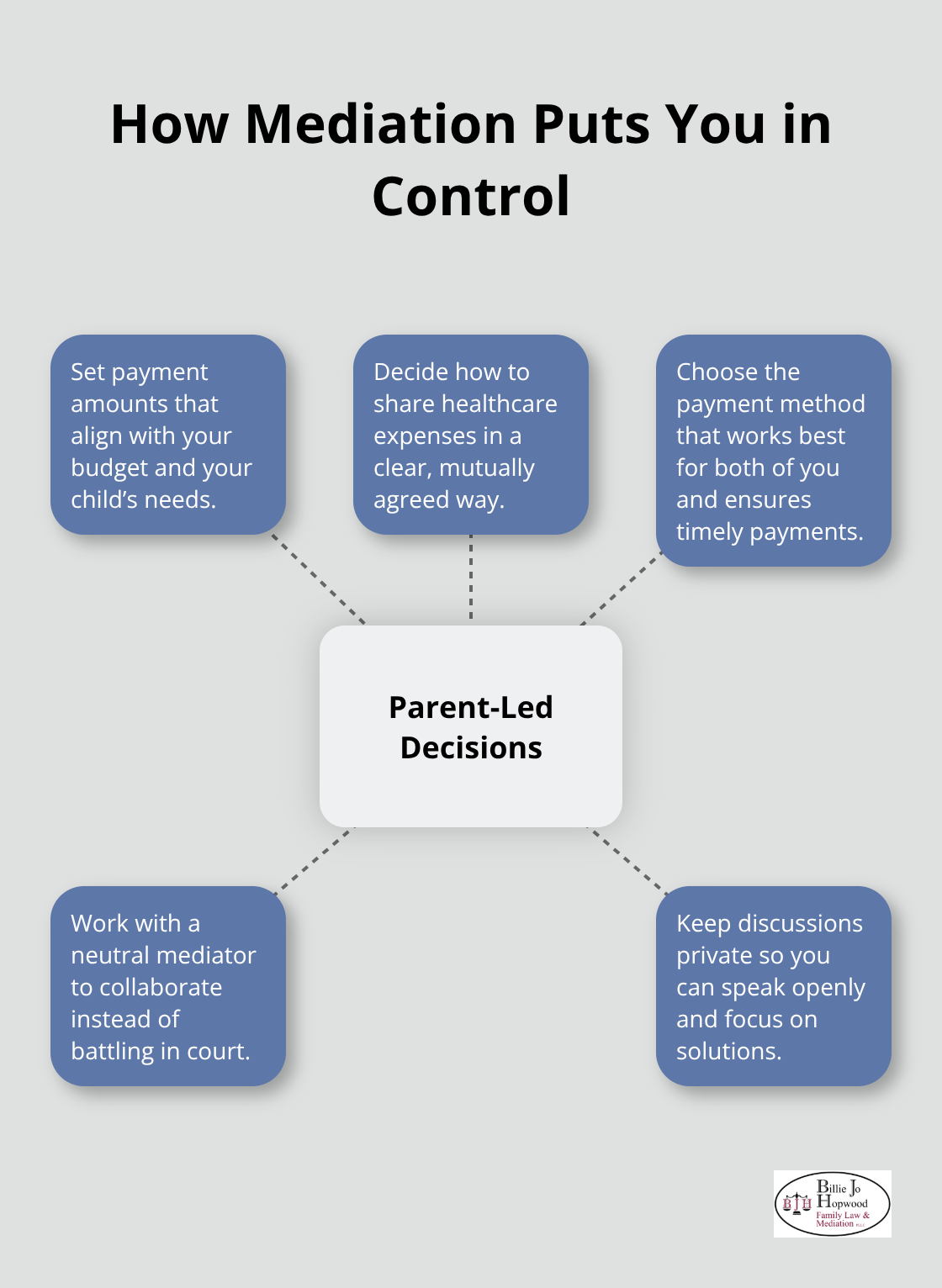
Mediation flips this dynamic entirely. Instead of a judge imposing a decision, a neutral mediator facilitates conversations where you and the other parent work toward an agreement together. You retain control over every detail-from payment amounts to how healthcare expenses are handled to the specific payment method that works best for your situation.

Visual showing key ways mediation gives parents control over child support agreements - Fair child support mediation

Why Control Matters in Your Agreement

Court proceedings are public record, and the final order reflects what a judge believes is fair based on Florida’s child support guidelines, which combine each parent’s monthly net income according to Florida’s Child Support Guidelines Worksheet. This means a stranger in a robe determines the financial terms that affect your family for years.

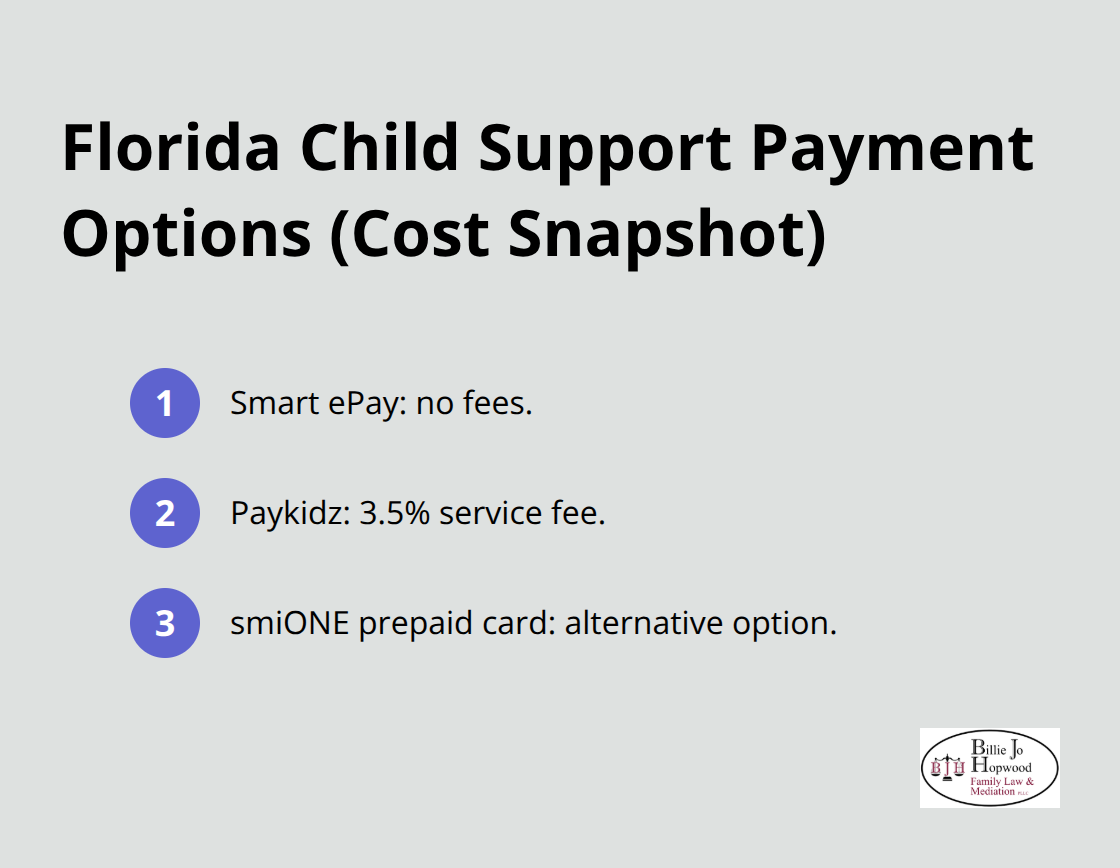
Mediation lets you choose the lowest-cost payment option that ensures timely payments. The Florida Child Support Program offers multiple payment options including Smart ePay with no fees, Paykidz with a 3.5% service fee, and smiONE prepaid cards. You select what works for your situation rather than accepting whatever the court assigns.

Confidentiality and Speed Change Everything

Mediation is confidential, so discussions cannot be used as evidence in court if you don’t reach an agreement. This means you can speak openly without fear. The process typically resolves in weeks rather than months, and because both parents helped create the plan, agreements reached in mediation tend to stick-parents follow orders they designed themselves far more consistently than orders imposed by a judge.

You’ll need accurate financial information from both parents, including Family Law Financial Affidavits showing monthly net income, but the calculation process becomes collaborative rather than combative. This approach aligns with Florida law, which requires parents to attempt mediation before a custody trial, recognizing that cooperation produces better outcomes for children than adversarial courtroom battles.

What Happens When You Choose Mediation

The shift from litigation to mediation changes not just the timeline but the relationship between parents moving forward. When both parents participate in creating the support arrangement, they understand the reasoning behind each number and feel invested in making the plan work. This foundation of mutual agreement reduces future disputes and modifications.

Understanding these differences helps you recognize why mediation produces faster resolutions and lower costs than litigation for families who want genuine input into their child support arrangement. The next section explores the specific benefits that make mediation the preferred choice for many Melbourne, Florida parents facing child support decisions.

Why Mediation Costs Far Less Than Court

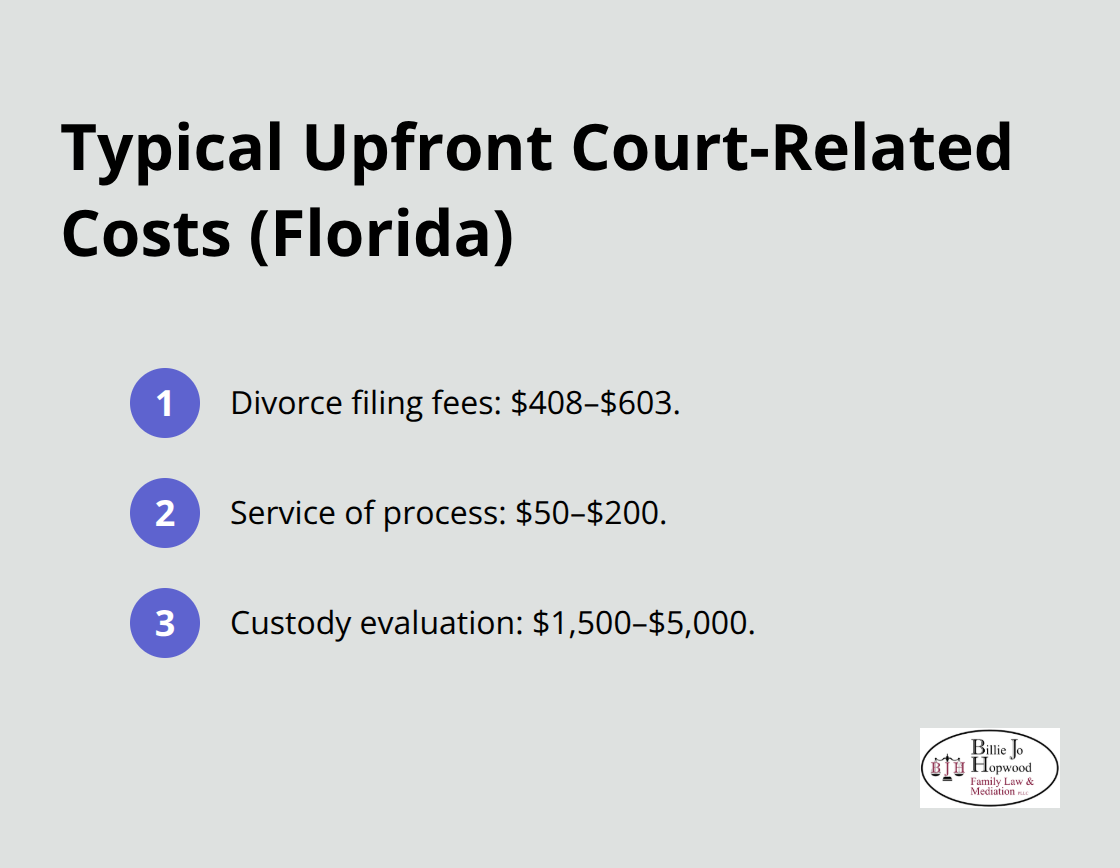
Litigation devours money in ways that sneak up on families. Court battles in Florida typically require attorney fees ranging from several thousand to tens of thousands of dollars, depending on complexity and how long the case drags through the system. You pay for every hour your attorney spends preparing documents, attending hearings, waiting in courtrooms, and responding to discovery requests from the other side. Meanwhile, court filing fees, expert witness costs for financial evaluations, and mandatory evaluations add thousands more before a judge ever makes a decision.

Mediation strips away these layers of expense. The mediator’s fee splits between both parents, typically costing far less per hour than two separate attorneys billing simultaneously. You avoid court filing fees entirely. No expert witnesses. No prolonged discovery processes. Most mediation cases resolve in a handful of sessions, meaning you pay for actual progress rather than procedural delays. Families in Melbourne, Florida consistently report spending 40 to 60 percent less on mediation than they would on contested litigation, though costs vary based on case complexity and whether you hire an attorney for consultation outside mediation.

Percentage range of cost savings families report when choosing mediation over contested litigation - Fair child support mediation

Agreements You Create Stick Far Better Than Court Orders

Court orders fail at alarming rates because parents resent terms they had no hand in creating. The moment a judge imposes a support amount, one parent typically views it as unfair and begins looking for ways to challenge or modify it. Mediation agreements follow the opposite trajectory. When both parents negotiate the support amount themselves, they understand the calculation behind every dollar and feel ownership of the outcome.

This psychological investment translates into compliance. Parents follow agreements they designed themselves far more consistently than orders imposed from the bench. Fewer modifications mean fewer attorney consultations down the road. Fewer disputes mean no additional court filings or enforcement proceedings.

Stability Saves Money Across Years

The State Disbursement Unit processes each payment and distributes funds smoothly when both parents understand and accept the arrangement. This stability saves money across years, not just months. Additionally, mediation preserves your relationship with the other parent, which matters enormously when you coordinate parenting time, school schedules, and healthcare decisions for years ahead.

A collaborative process now prevents expensive conflicts later. When parents work together to establish support terms, they build a foundation for ongoing cooperation. This foundation reduces the likelihood of future disputes that would require additional legal intervention or court involvement. The financial benefits extend well beyond the initial mediation sessions.

How Payment Methods Affect Your Bottom Line

The Florida Child Support Program offers multiple payment options, and your choice directly impacts total costs. Smart ePay carries no fees, while Paykidz charges a 3.5% service fee, and smiONE prepaid cards present another alternative. In mediation, you select the lowest-cost payment option that ensures timely payments rather than accepting whatever the court assigns.

Quick comparison of Florida Child Support Program payment methods and their fees

This control over payment logistics represents another way mediation reduces unnecessary expenses that families face in litigation scenarios.

Understanding these cost differences helps you recognize why mediation produces financial savings that extend far beyond attorney fees. The next section explores the specific benefits that make mediation the preferred choice for many Melbourne, Florida parents facing child support decisions.

What Gets Resolved in Mediation Sessions

Mediation tackles the three areas that create the most friction in child support disputes: calculating the correct payment amount, handling changes in circumstances, and deciding who covers healthcare and education costs. These issues consume court time and attorney fees because litigation forces rigid adherence to formulas without room for creative solutions that actually fit your family’s situation. Mediation addresses each area through direct negotiation where both parents understand the math and reasoning behind every decision.

Income Calculations That Actually Reflect Your Reality

Florida’s Child Support Guidelines Worksheet requires each parent to file a Family Law Financial Affidavit within 45 days, showing monthly net income calculated by subtracting taxes and court-approved deductions from gross income. This step one of the formula matters enormously because it determines everything that follows. In mediation, both parents review these affidavits together, which immediately surfaces discrepancies and prevents the calculation errors that plague contested cases.

The combined monthly net income from both parents then determines the basic monthly obligation based on the number of children involved. For two children, the baseline obligation sits around $1,803 according to Florida’s Guidelines Worksheet, though this figure varies significantly based on combined income. In mediation, you calculate each parent’s percentage of financial responsibility by dividing their individual net income by the combined total, then apply that percentage to the basic obligation. This transparency means no surprises and no accusations of hidden income later.

Time-sharing arrangements dramatically affect these numbers in ways that court calculations sometimes miss. When both parents have 73 or more overnight visits per year with the child (roughly 20 percent of annual time), the formula applies a time-sharing adjustment that lowers the higher-income parent’s share. Mediation lets you accurately input your actual time-sharing plan rather than estimating or fighting over hours. Precise time-sharing data can shift support amounts by thousands of dollars annually, making accuracy critical to fairness.

Adjusting Orders When Life Actually Changes

Life circumstances shift constantly, yet court orders remain static until someone files a modification request, which costs money and court time. Mediation establishes a foundation for addressing changes collaboratively without returning to court. When a parent loses employment, experiences a significant income change, or shifts to part-time work, mediation allows you to recalculate support immediately rather than waiting for a court date months away.

The Florida Department of Revenue can automatically modify orders when circumstances change substantially, but mediation gives you control over how that modification happens and ensures both parents agree the change reflects reality. Healthcare and educational expenses deserve separate attention because they sit outside the basic support calculation. These costs get allocated proportionally based on each parent’s financial responsibility percentage, meaning the parent with higher income typically covers a larger share.

In mediation, you address these expenses directly and decide whether one parent will pay certain costs entirely while the other covers different expenses, creating a division that works better than the proportional split the formula produces. This flexibility prevents disputes over who owes what when unexpected medical or educational needs arise.

Final Thoughts

Fair child support mediation transforms how families move forward after separation or divorce. Rather than accepting a judge’s decision imposed from the bench, you and the other parent build an agreement together that reflects your actual circumstances and priorities. This collaborative approach creates stability for your children while preserving the co-parenting relationship you’ll maintain for years ahead.

Gather your financial documents, including recent pay stubs and tax returns, so both parents can calculate accurate net income using the Family Law Financial Affidavit. Identify your time-sharing arrangement and any special expenses your children require, then address these concrete details during productive mediation sessions where both parents work toward terms that feel fair and sustainable. When circumstances change, you adjust together rather than filing expensive modification requests.

Melbourne, Florida families benefit from understanding that mediation isn’t about splitting differences down the middle or accepting whatever the other parent demands. We at Billie Jo Hopwood Family Law & Mediation, PLLC assist families through these challenging decisions with compassionate guidance grounded in family law, and our team in Melbourne, Florida helps you move forward with confidence. Contact us to discuss how mediation can support your family’s journey toward stability and cooperation.

Equitable Distribution Mediation: How Property Is Divided Fairly

Divorce means dividing everything you’ve built together, and Florida law requires that division to be fair-not necessarily equal. Equitable distribution mediation gives you control over how your assets, debts, and property are split instead of leaving those decisions to a judge.

We at Billie Jo Hopwood Family Law & Mediation, PLLC help couples in Melbourne, Florida navigate this process with clarity and confidence. This guide walks you through how equitable distribution works and why mediation often produces better results than courtroom battles.

How Florida Defines and Divides Marital Property

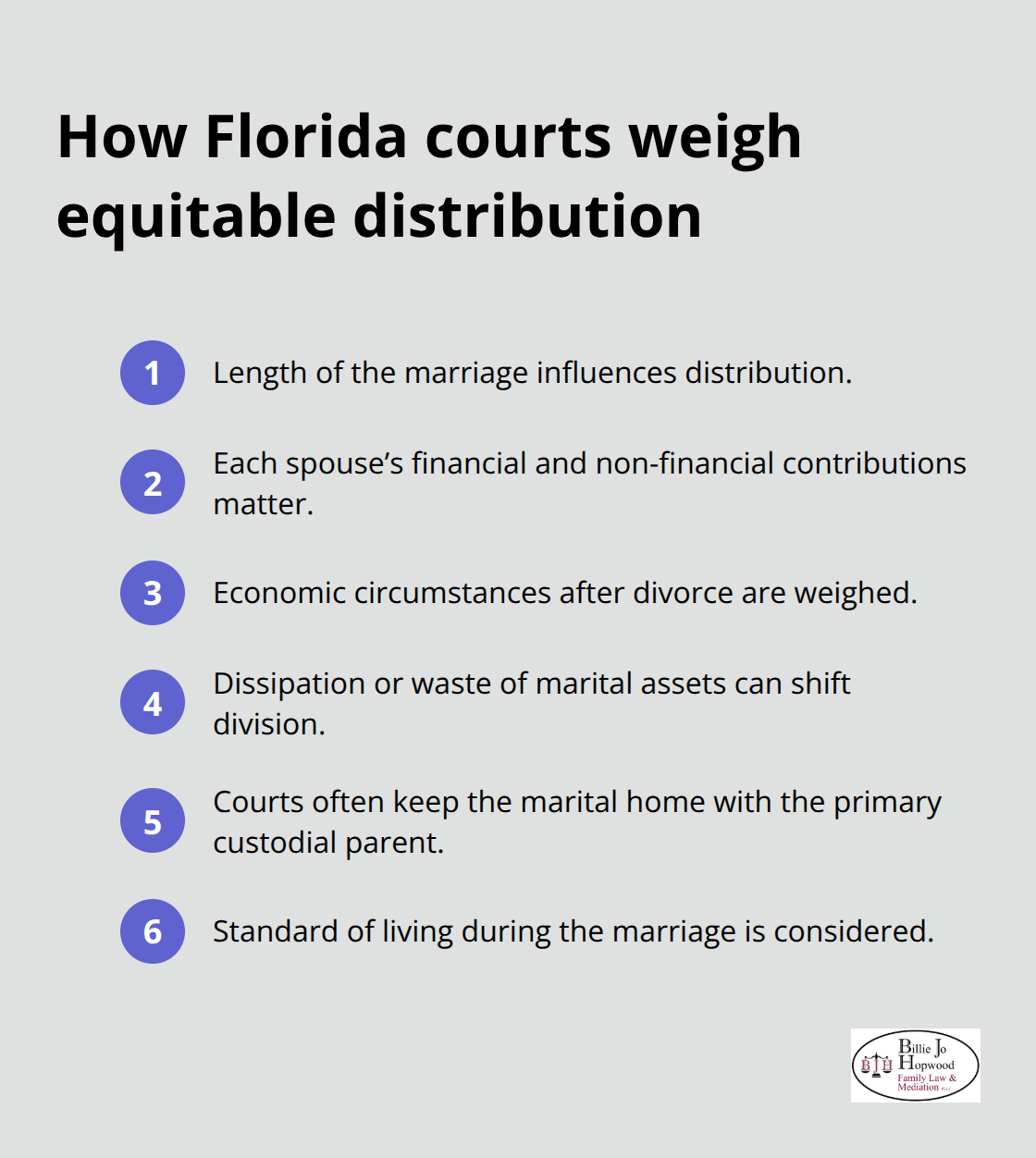
Florida Statute 61.075 controls equitable distribution, and the law is clear: only property acquired during the marriage gets divided. Anything you owned before marriage, inherited, or received as a gift stays yours. This distinction matters enormously because it determines what’s on the table. Courts examine ten specific factors when deciding how to split marital assets fairly, and the marriage’s length carries substantial weight. A 20-year marriage triggers different distribution considerations than a 5-year one. The statute also accounts for each spouse’s contributions-both financial and non-financial. If one spouse sacrificed career opportunities to raise children or support the other’s education, courts recognize that sacrifice in the division.

Key factors Florida judges consider when dividing marital property - Equitable distribution mediation

What Actually Counts as Marital Property

Commingling creates the biggest problem most people face. When you deposit an inheritance into a joint account or use pre-marriage savings to improve a home you bought together, those assets become harder to classify. Courts examine the source of funds and your intent. If you inherited money but kept it separate in your own account, it likely stays non-marital. If you mixed it with joint funds or used it to benefit the marriage, courts may view it differently.

Retirement accounts complicate things further. A 401(k) earned during the marriage is marital property, even if only one spouse’s name appears on it. The portion accumulated before marriage stays separate, but contributions made while married get divided. This is why detailed financial records matter-you need to show exactly when assets were acquired and whose money funded them.

How Courts Apply the Ten Distribution Factors

Courts do not split everything 50-50. Instead, judges weigh factors like each spouse’s economic circumstances after divorce, career interruptions, and whether one spouse sacrificed earning potential. If you stayed home while your spouse built a business, courts consider that contribution when deciding distribution. The statute also examines whether one spouse dissipated assets-spent marital money on affairs or wasteful purchases-which can shift the division in the other spouse’s favor.

Courts prioritize keeping the marital home with the parent who has primary custody of children, minimizing disruption to their routine. This practical approach recognizes that stability matters more than strict mathematics. The length of marriage and each spouse’s standard of living during the relationship shape how assets are allocated to maintain financial balance going forward.

Why Mediation Handles These Complexities Better Than Court

Understanding these factors helps you prepare for mediation, where you control the outcome rather than leaving decisions to a judge. The next section explains how the mediation process actually works and what steps you need to take to protect your financial interests.

Mediation Gives You Control Over Your Property Division

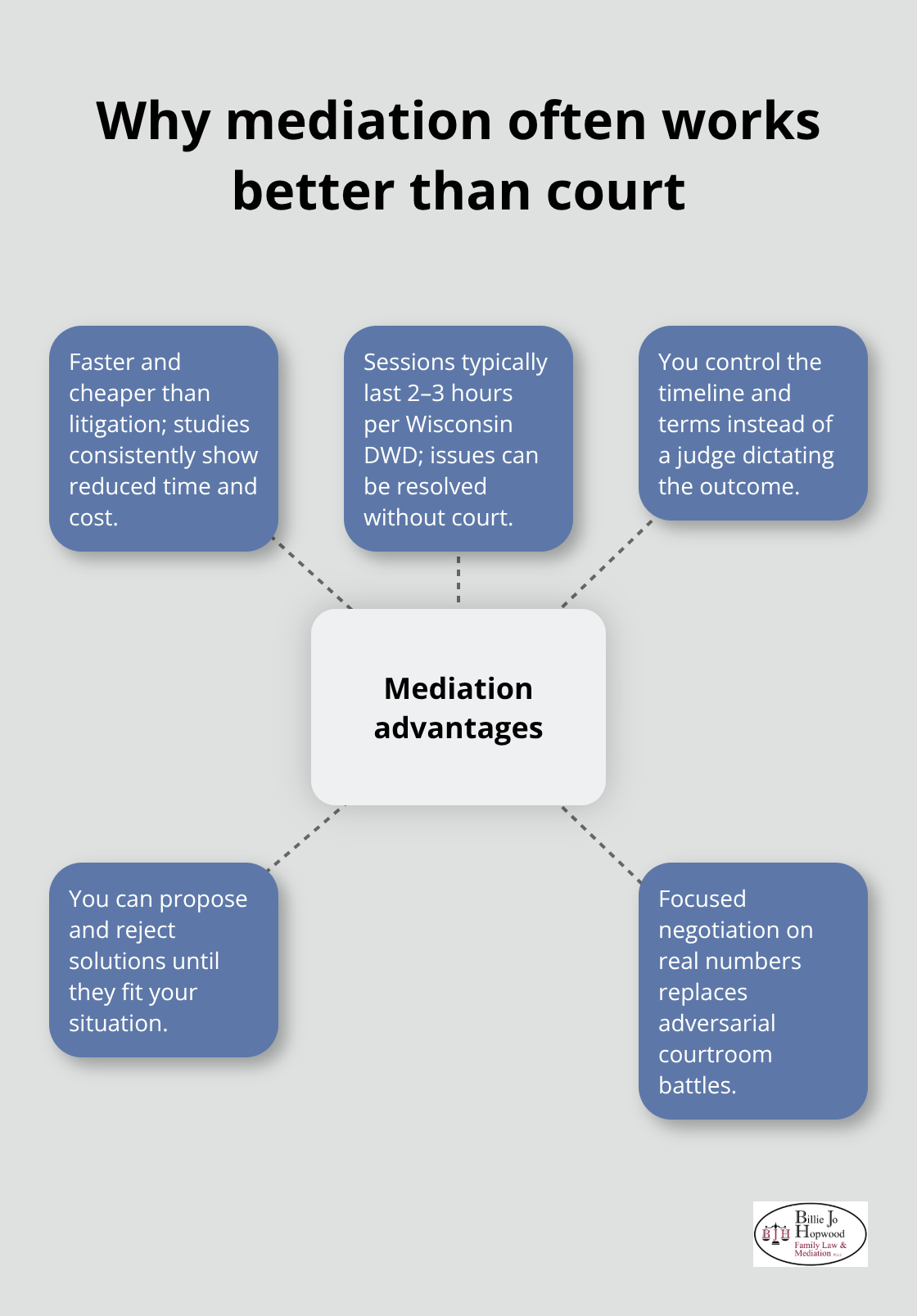
Mediation fundamentally shifts power from the judge to you and your spouse. In court, a judge reviews financial documents, hears arguments, and makes decisions based on the ten statutory factors-but you have no say in the outcome. Mediation lets you negotiate directly, propose solutions, and reject proposals that don’t work for your situation. Studies show mediation resolves property disputes faster and cheaper than litigation. The Wisconsin Department of Workforce Development tracks mediation statistics and confirms that mediation sessions typically run 2-3 hours and can resolve financial disagreements without court involvement. You control the timeline, the terms, and whether to accept an agreement.

Benefits of mediation in Florida property division

Prepare Your Financial Records Before Mediation Starts

Complete financial documentation determines how efficiently your mediation sessions proceed. You need bank statements, property deeds, investment account statements, retirement account documentation, and loan records-everything showing what assets exist, when you acquired them, and whose money funded them. A qualified mediator will provide you with a detailed list of required documentation before your first session. Coming prepared with complete financial records cuts mediation costs significantly because your mediator spends less time hunting for missing information and more time facilitating fair negotiations.

Schedule Sessions When You Can Focus Fully

Mediation demands mental stamina, so you must schedule sessions when you’re alert and can focus for 2-3 hours without interruption. Avoid scheduling back-to-back sessions or sessions that overlap with other commitments, since property division discussions are mentally demanding and sessions sometimes run longer than planned. Your ability to think clearly directly affects the quality of agreements you reach.

Identify Your Priorities and Non-Negotiables

Know your priorities before walking into mediation. Identify which assets matter most to you-the family home, retirement accounts, business interests, or vehicles-and decide what you’re willing to trade. Flexibility improves your chances of reaching a mutually acceptable agreement, but clarity on non-negotiables prevents you from accepting unfair terms under pressure. Discuss property division basics with your spouse in advance if possible, so mediation sessions focus on unresolved disputes rather than rehashing fundamentals.

Understand the Legal Framework Before You Negotiate

Understanding Florida Statute 61.075 and the ten distribution factors helps you recognize when proposed divisions align with legal standards. This knowledge prevents you from accepting settlements that leave you financially vulnerable after divorce. The mediator guides identification, valuation, and negotiation to reach fair resolution, but your preparation determines whether that resolution protects your actual interests. With solid preparation complete, you’re ready to address the specific challenges that most couples face during property division-and how mediation strategies help you overcome them.

What Makes Property Division Disputes So Hard to Resolve

Valuing Complex Assets Requires Professional Analysis

A business owner might claim their company is worth $500,000 based on revenue, but actual value depends on profit margins, debt obligations, customer contracts, and whether the business survives without the owner’s involvement. If the owner leaves, does the business collapse? That reality determines true worth. Retirement accounts present similar complications because the portion earned during marriage differs from pre-marriage contributions, and dividing a 401(k) requires a Qualified Domestic Relations Order to avoid massive tax penalties. Many couples don’t realize that splitting a retirement account without proper documentation triggers immediate taxation and 10% early withdrawal penalties, potentially reducing the recipient’s actual benefit by 30-40%.

Mediation forces both parties to obtain professional appraisals and valuations before negotiating, which takes time but prevents accepting unfair numbers based on guesswork. A mediator will require current statements, historical contribution records, and often recommendations from financial professionals to establish true values. This transparency eliminates the temptation to hide asset value or claim inflated worth.

Debt Distribution Creates Equal Complications

Debt creates equal headaches because couples often disagree about who should shoulder mortgages, credit card balances, or business loans. Equitable distribution of both assets and liabilities means debts accumulated during marriage get divided fairly too. One spouse might argue they should keep the house free of the mortgage while the other takes cash assets, but that math rarely works without one party absorbing unfair burden.

Mediation requires full financial disclosure from both spouses, and mediators catch inconsistencies quickly when statements don’t match or accounts appear unexplained. The Wisconsin Department of Workforce Development reports that mediation sessions typically resolve 2-3 hours of discussion, which forces focused attention on actual numbers rather than emotional arguments. When both parties see complete financial pictures simultaneously, disputes over asset values and debt allocation become solvable problems rather than trust-based standoffs.

Documentation Prevents Commingling Problems

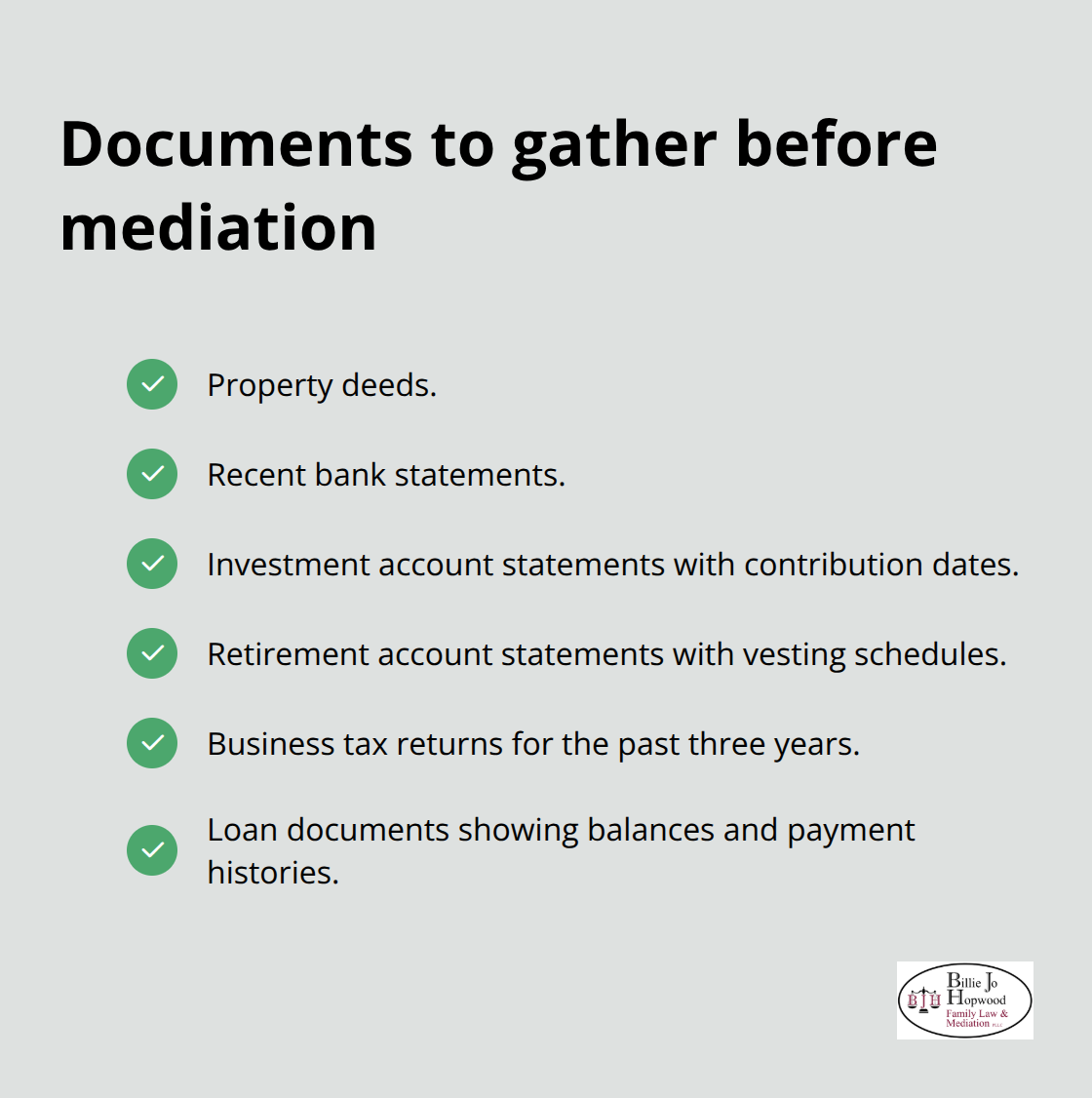
The strongest protection for both parties during property division is preparation and documentation before mediation starts. Gather property deeds, recent bank statements, investment account statements showing contribution dates, retirement account statements with vesting schedules, business tax returns for the past three years, and loan documents showing balances and payment histories.

Checklist of financial records for Florida equitable distribution mediation

Commingling of funds complicates everything, so trace the source of money used for major purchases. If you inherited $50,000 and deposited it into a joint account used for home improvements, courts may view that inheritance as marital property. Documentation proving separate deposit and use prevents this problem.

Tax Consequences Affect Real Settlement Value

Tax consequences matter enormously when dividing assets, and many couples overlook how selling real estate or liquidating investments creates tax liability. A home sale triggers capital gains tax, and certain retirement account transfers create unexpected tax bills. Mediators increasingly recommend consulting a tax professional before finalizing property division agreements to understand actual after-tax value of proposed settlements. Identify which assets carry tax consequences and which don’t, then adjust your negotiations accordingly. Some couples agree to a seemingly fair split only to discover one party received assets worth significantly less after taxes.

The mediator’s role includes guiding you toward valuations and divisions that account for these real-world consequences, not just nominal numbers on paper.

Final Thoughts

Equitable distribution mediation in Melbourne, Florida gives you control over your financial future after divorce that court litigation cannot match. Florida law requires fair division of marital assets and debts, but fairness looks different for every couple, and a judge cannot know whether you value the family home more than retirement security or whether your spouse’s career sacrifice deserves recognition beyond statutory minimums. Mediation accommodates these human realities because you propose solutions, reject unfair offers, and walk away only when you’ve reached genuine agreement.

The process works because transparency forces honesty and produces settlements both parties can live with long-term. When both spouses provide complete financial documentation and sit across from a neutral mediator, hidden assets surface and inflated valuations collapse under scrutiny. Studies confirm mediation resolves property disputes faster and cheaper than courtroom battles, and most sessions conclude within 2-3 hours of focused discussion where you see actual numbers, understand tax consequences, and negotiate from reality rather than emotion or fear.

If you’re facing property division and want to understand your options, contact us for guidance on protecting your financial interests through equitable distribution mediation rather than litigation. We at Billie Jo Hopwood Family Law & Mediation, PLLC help families in Melbourne, Florida navigate this process with confidence and clarity.

Legal and Ethical Considerations for Group and Family Therapy

Group and family therapy sessions involve multiple people sharing sensitive information in a single room. This creates unique legal and ethical challenges that therapists must navigate carefully.

We at Billie Jo Hopwood Family Law & Mediation, PLLC understand that the legal and ethical considerations for group and family therapy extend far beyond standard one-on-one practice. Confidentiality rules shift when multiple participants are present, consent becomes more complex, and reporting obligations can create difficult situations.

Confidentiality and Privacy in Group and Family Therapy

When multiple people sit in the same room discussing personal matters, confidentiality becomes complicated in ways that therapists often underestimate. The American Association for Marriage and Family Therapists revised its Code of Ethics on January 1, 2026, and made clear that therapists cannot guarantee confidentiality among group participants themselves-only within the therapist-client relationship. This distinction matters enormously. In individual therapy, you control who hears what. In group or family settings, you cannot control what participants tell others after they leave.

Establishing Confidentiality Norms Across Multiple Participants

The AAMFT standards require you to establish explicit group confidentiality norms and remind members regularly that while you maintain confidentiality, other participants may not. Your written informed consent documents must address this directly. Specify what information can be shared outside sessions, what remains private, and what happens if someone breaches group confidentiality. Many therapists skip this step or bury it in generic consent forms, then face complaints when a family member repeats something shared in a joint session. The APA Ethics Code and AAMFT guidance both insist on plain-language disclosure at the outset and ongoing reminders throughout treatment.

Key confidentiality safeguards therapists should set and document in group and family therapy. - legal and ethical considerations for group and family therapy

Your records must reflect these conversations. Document when you reviewed confidentiality limits, what you said, and how participants responded.

Managing Disclosures Between Family Members

In family therapy, managing disclosures between members creates constant ethical tension. One parent might tell you something about the other parent or about a child’s behavior that directly affects treatment. The revised AAMFT Code prohibits you from disclosing any individual’s confidences to others in the client unit without prior written permission from that individual. This applies even when full family sessions are happening. If a teenager reveals substance use in a private moment before a family session, you cannot tell the parents without the teen’s consent-unless safety is at stake. When safety concerns emerge, you must know your jurisdiction’s mandatory reporting laws. The duty to warn applies when imminent danger exists, but the threshold varies by location. Document your safety assessment, the specific danger you identified, and steps you took in response. A documented safety plan with emergency contacts and local crisis resources like the 988 Suicide & Crisis Lifeline protects both clients and your practice. Your records should show the clinical reasoning behind each decision to disclose or withhold information.

Record Retention and Access Requirements

The Medical Council of India guidelines recommend keeping records for at least three years, and many states require longer retention. When someone requests access to group or family therapy records, written authorization from each individual competent to consent is required-this means you cannot hand over records to one family member without permission from others, even if they all attended the same sessions. Physical and digital records must be stored separately from personal clinician notes and kept secure with limited access to authorized personnel. HIPAA compliance is non-negotiable for any practice handling protected health information, and many state licensing boards impose additional requirements beyond federal standards. When clients request their records, you have a short window to respond. The Medical Council of India requires responses within 72 hours, and many U.S. jurisdictions follow similar timelines.

Planning for Practice Changes and Data Security

Plan ahead for what happens to records if your practice closes, relocates, or changes ownership. Arrange secure storage, transfer, or disposal in compliance with your state’s laws. Breaches must be reported promptly to affected individuals and, depending on jurisdiction, to regulatory bodies. The cost of a breach notification far exceeds the cost of proper record management from day one. These confidentiality safeguards form the foundation for the next critical area: obtaining informed consent that actually protects both you and your clients.

Informed Consent and Ethical Boundaries

Informed consent in group and family therapy fails most therapists because they treat it as a checkbox rather than an ongoing conversation. The revised AAMFT Code of Ethics requires consent before starting services and throughout treatment, but many practitioners hand clients a generic form, get a signature, and never address consent again. This approach leaves you exposed legally and ethically.

Written Consent Documents That Protect Both Parties

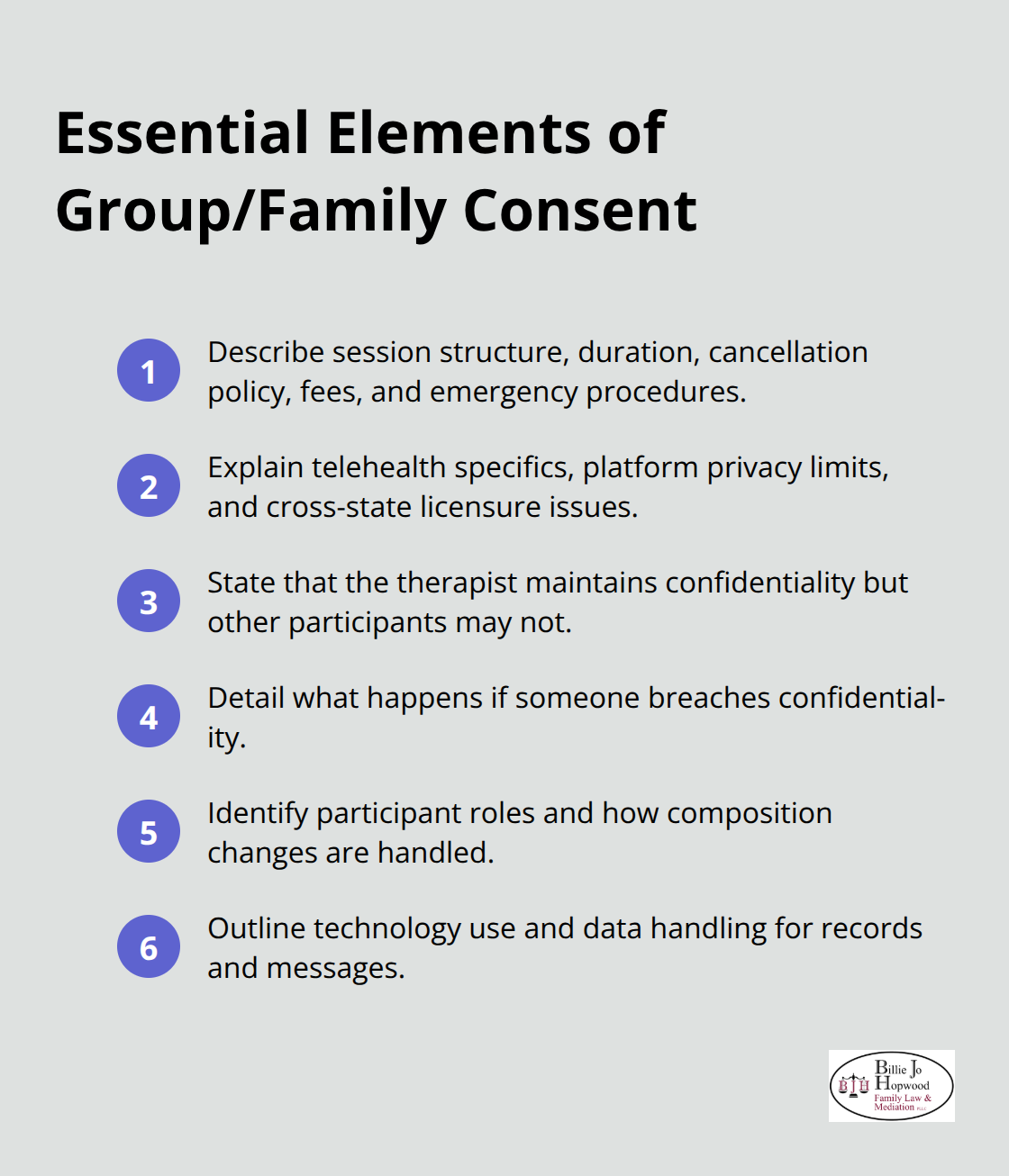
Your written consent document must be understandable to the people who sign it-plain language matters more than legal precision here. Cover the specific risks and benefits of group or family treatment, not vague platitudes. State exactly what happens during sessions, how long they last, what the cancellation policy is, what fees apply, and what emergency procedures exist. Address technology use explicitly if you conduct telehealth sessions, including platform privacy limitations and cross-state licensure considerations. Most critically, explain that the therapist maintains confidentiality but other participants may not, and describe what happens if someone breaches confidentiality.

Compact list of the core items every group or family therapy consent should include.

Consent as an Ongoing Process, Not a One-Time Event

The APA Ethics Code and ACA guidelines both emphasize that informed consent is not a one-time form but an evolving process. You should revisit key points periodically, especially before major treatment shifts or when new participants join. Document these conversations in your clinical notes. One therapist’s mistake was obtaining written consent for a couple’s therapy session, then later adding the couple’s adult child to sessions without updating the consent document or discussing how this changed confidentiality dynamics. That oversight created liability when the child later complained they weren’t informed about what information might be shared. Your consent document should specify how many people will participate, their roles, and what happens if the composition changes.

Identifying and Addressing Power Imbalances

Power imbalances in family and group settings require active intervention, not passive observation. The AAMFT Code prohibits abusing the therapeutic relationship for power and requires you to respect client autonomy. In family therapy, one parent often holds more financial or social power than the other, or a teenager may fear speaking openly because they live with the more dominant parent. In group settings, an older member or someone with higher status may inadvertently silence others. You must identify these imbalances early and address them directly in sessions.

Some therapists avoid this because it feels confrontational, but failing to address power dynamics violates your ethical duty. Establish explicit ground rules at the first session: everyone receives uninterrupted speaking time, no one can speak for another person, and interruptions are off-limits. In family therapy, consider individual sessions with each member before joint sessions begin. These private meetings let you understand each person’s perspective and safety concerns without others present.

Documenting Boundary Work and Interventions

The 2026 AAMFT Code requires clear boundaries within the therapeutic relationship, and part of that means preventing dominant participants from controlling the narrative. If one family member repeatedly interrupts or dismisses another, stop the session and address it. Say something like: “We’re going to pause here because I notice that pattern is happening again, and it prevents us from hearing everyone’s perspective.” If group members begin forming alliances that exclude or demean others, intervene immediately. Document these interventions in your progress notes because they demonstrate you recognized the power dynamic and took clinical action. Avoiding this documentation suggests you missed the problem entirely.

These boundary protections form the foundation for your legal obligations. Understanding when you must disclose information-and when you cannot-determines whether your practice survives scrutiny.

Mandatory Reporting and Legal Obligations

Mandatory reporting laws override confidentiality, and this reality creates the hardest decisions therapists face in group and family settings. The 2026 AAMFT Code of Ethics requires you to comply with laws regarding reporting of alleged unethical conduct, and state mandatory reporting statutes trump your ethical duty to keep information private. Most states require reports of child abuse and neglect, elder abuse, and imminent danger to self or others, but the specific triggers and timelines vary significantly by jurisdiction.

Know Your State’s Exact Reporting Requirements

Florida’s mandatory reporting law requires reports to the Department of Children and Families within 24 hours of learning about suspected child abuse or neglect, and failure to report is a felony if the person knew or should have known about the abuse. You cannot wait for a family session to end or consult with a supervisor before making that call. The moment you have reasonable suspicion, you must report. This means you need to know your state’s exact definitions before you ever see a family or group client.

Many therapists operate under vague assumptions about what counts as reportable abuse, then face licensing board complaints when they either over-report minor parenting disagreements or under-report actual harm. Get your state’s mandatory reporting statute in writing, highlight the specific triggering language, and keep it accessible during sessions. When a parent mentions spanking a child with a belt, you must know whether your jurisdiction considers that reportable abuse or permissible discipline.

Assess and Document Safety Concerns

When a teenager describes an older sibling’s inappropriate touching, you must recognize that as sexual abuse and understand your reporting window. When a family member expresses plans to harm themselves or another person, you must assess imminent danger versus general hopelessness and know whether your state’s duty to warn applies to family members or only to identifiable third parties.

Document your safety assessment with specificity that protects your license. Write down exactly what the person said, your clinical reasoning for whether it met the threshold for reporting, and what action you took. If you decided not to report, document why the behavior did not meet your state’s legal definition of reportable abuse or why the danger was not imminent. If you decided to report, document the date, time, agency you contacted, and the name of the person who received your report.

Handle Suicidal Ideation and Crisis Situations

Some therapists fear that documenting a decision not to report creates liability, but the opposite is true: failing to document your reasoning looks like you missed the problem entirely. The 988 Suicide and Crisis Lifeline provides immediate support when clients express suicidal ideation, and you should provide that number to every family or group participant at intake.

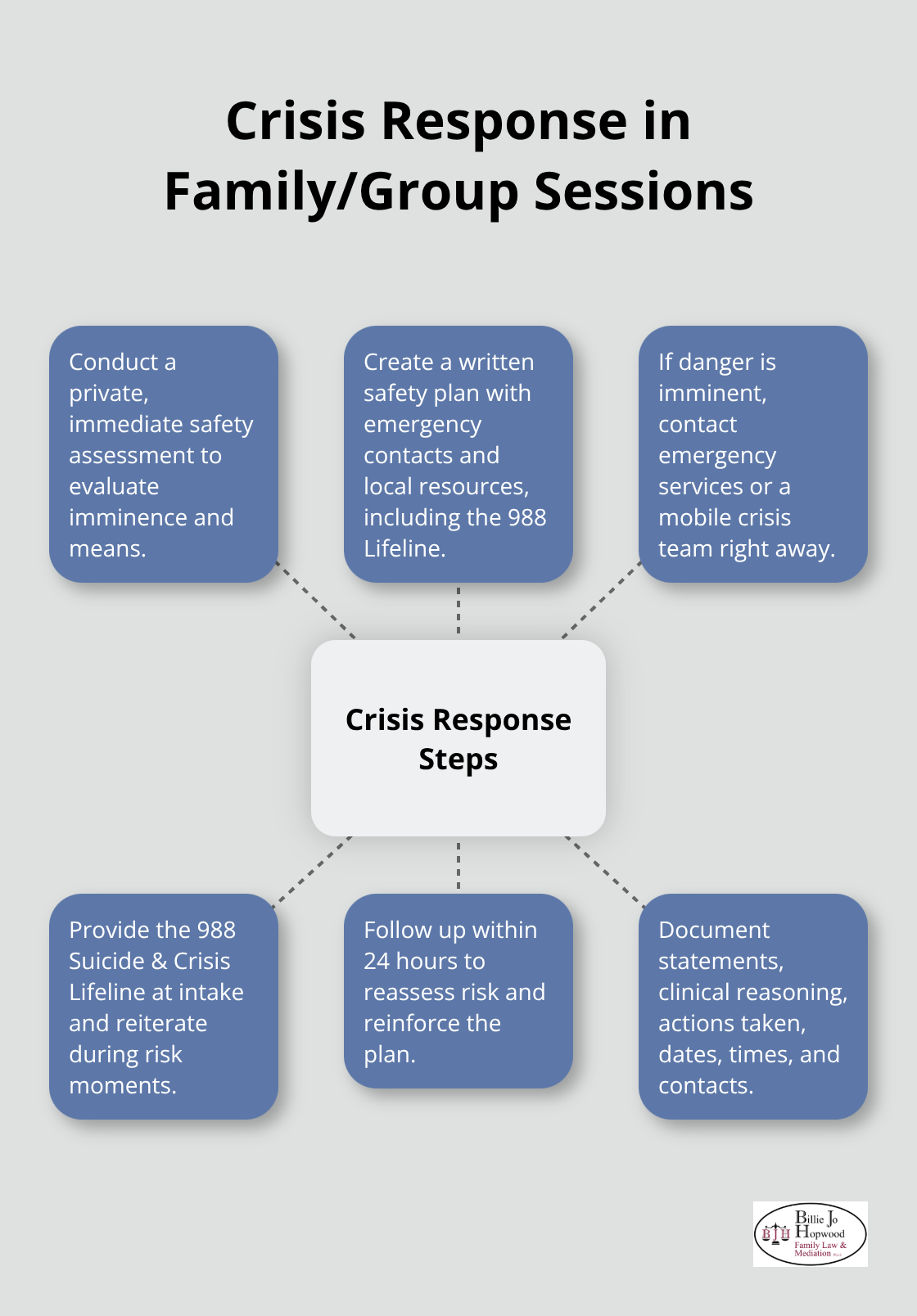
Hub-and-spoke visual of immediate steps when suicidal ideation or imminent danger is disclosed in session. - legal and ethical considerations for group and family therapy

When someone in a family session says they have thought about killing themselves, do not rely on the family members present to keep them safe. Conduct a private safety assessment before the session ends, create a written safety plan with emergency contacts, and follow up within 24 hours. If imminent danger exists, contact emergency services or a crisis team directly.

Disclose Confidentiality Limits Upfront

Your written informed consent documents must clearly state that you will breach confidentiality to report abuse, prevent harm, or comply with court orders, and you must explain this at the first session without waiting for a crisis to arise. This transparency prevents clients from feeling blindsided when you must report, and it demonstrates your commitment to both legal compliance and ethical practice.

Final Thoughts

Documentation protects your practice and your clients simultaneously. Every confidentiality conversation, every safety assessment, every boundary intervention, and every decision to report or withhold information must appear in your clinical notes. Vague notes that say “discussed confidentiality” without specifics suggest you missed critical details, while detailed notes that explain what you said, how participants responded, and what you decided demonstrate you took your ethical duties seriously.

Transparent communication prevents most ethical problems before they start. Your written informed consent documents must address confidentiality limits, group rules, fees, cancellation policies, and what happens if someone breaches confidentiality. When you explain upfront that you will report abuse or imminent danger, clients understand your obligations rather than feeling betrayed when you must disclose information. Knowledge of your jurisdiction’s laws is non-negotiable-mandatory reporting thresholds, record retention requirements, and duty to warn standards vary by state, and Florida’s 24-hour reporting window for suspected child abuse differs from other states’ timelines.

If you work with families navigating divorce, custody disputes, or mediation, we at Billie Jo Hopwood Family Law & Mediation, PLLC in Melbourne, Florida understand the intersection of family law and therapeutic practice. When your clients need legal guidance alongside their therapeutic work, contact Billie Jo Hopwood Family Law & Mediation, PLLC for compassionate representation. Seek supervision regularly, especially when boundary questions or reporting decisions feel unclear, and stay informed about changes to professional codes as the legal and ethical landscape evolves.

Family Caregiver Legal Rights: What You Need to Know

Family caregivers often face legal questions they never expected to encounter. From managing medical decisions to protecting themselves financially, the landscape of family caregiver legal rights can feel overwhelming without proper guidance.

At Billie Jo Hopwood Family Law & Mediation, PLLC, we help families navigate these complex situations. This guide walks you through the protections available to you and the steps needed to safeguard your interests.

Legal Protections and Financial Support for Family Caregivers

Federal Leave Laws That Protect Your Job

Sixty-three million Americans serve as family caregivers, yet most operate without understanding their legal rights. Federal and state laws do protect you, though the specifics depend on where you work and your caregiving situation. The Family and Medical Leave Act covers eligible employees at covered employers, allowing up to 12 weeks of unpaid, job-protected leave annually to care for a spouse, child, or parent with a serious health condition. If you care for a military family member, you may qualify for up to 26 weeks of military caregiver leave during a single 12-month period. This protection means your employer cannot fire you for taking leave, though the leave itself remains unpaid.

Paid Leave Programs in Your State

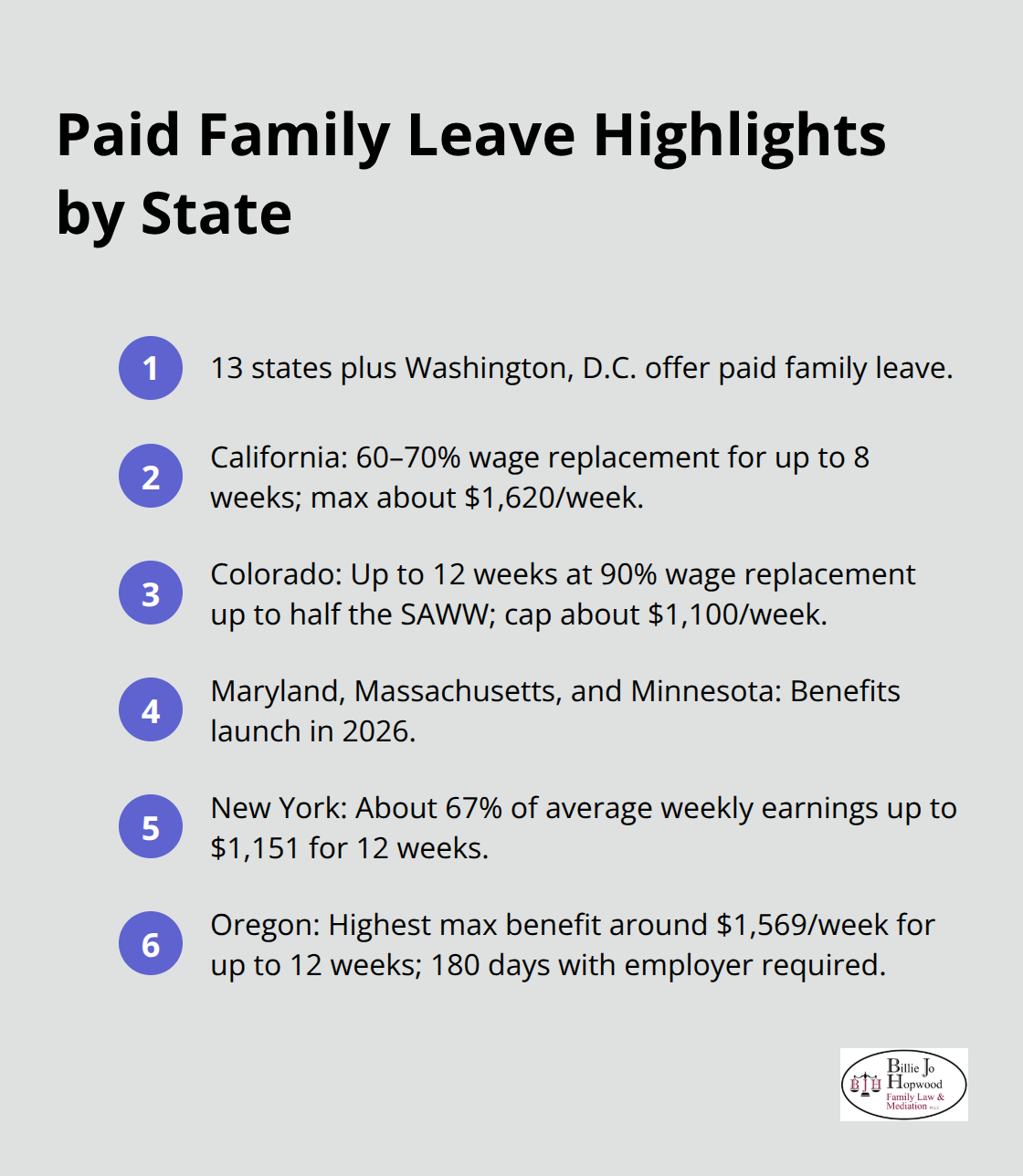
Beyond FMLA, 13 states plus Washington D.C. now offer paid family leave programs that provide wage replacement while you care for loved ones. California offers 60 to 70 percent wage replacement for up to 8 weeks per year, with maximum weekly benefits around $1,620. Colorado provides up to 12 weeks at 90 percent wage replacement up to half the state average weekly wage, capped at roughly $1,100 weekly. If you live in Maryland, Massachusetts, or Minnesota, paid leave benefits launch in 2026, expanding access significantly.

Key paid leave program highlights in the United States for family caregivers

New York pays approximately 67 percent of average weekly earnings up to $1,151 weekly for 12 weeks per year. Oregon offers the highest maximum benefit at around $1,569 weekly for up to 12 weeks, though you must have worked 180 days for your employer first.

Employer Benefits Beyond Legal Minimums

Many employers offer additional protections beyond legal minimums. Check your employee handbook or speak with human resources about what applies to your situation. The U.S. Department of Labor’s Wage and Hour Division provides free guides on discussing family leave with your employer. Contact them at 1-866-487-9243 if you believe your rights have been violated.

Tax Deductions and Caregiver Compensation Programs

Caregivers often absorb significant expenses without realizing tax deductions exist. If you provide more than half the annual support for a dependent family member, you may claim them as a dependent on your taxes, reducing your tax burden. Additionally, 11 million caregivers nationwide receive compensation through Medicaid, Veterans Affairs programs, or other state initiatives. Research your state’s caregiver compensation programs, as eligibility varies widely. Some states allow Medicaid to pay family members for in-home care, effectively converting unpaid caregiving into paid work. Many state labor departments offer workshops on caregiver benefits specific to your location.

When Legal Disputes Arise Over Care Authority

Understanding your financial rights forms only part of the picture. Family caregivers frequently encounter conflicts over who holds legal authority to make medical decisions, manage finances, or direct care. These disputes intensify when multiple family members disagree about the care recipient’s needs or when no formal legal documents exist to clarify your role.

When Disagreements Arise Over Care Authority and Legal Rights

Understanding Decision-Making Authority

Family caregivers often discover that financial protections mean little without clarity on who holds legal authority to make decisions. Seventy percent of caregivers work while providing care, according to Caregiving in the US 2025 from AARP and the National Alliance for Caregiving, yet most lack formal documentation establishing their decision-making power. Without a power of attorney or healthcare directive, hospitals refuse to discuss the care recipient’s condition with you, and siblings or distant relatives can override your care preferences.

Percentage of U.S. caregivers who work while providing care - family caregiver legal rights

Powers of Attorney: Financial Versus Healthcare

Powers of attorney come in two distinct forms, each granting different rights. Financial powers of attorney grant you authority to manage money and property, while healthcare powers of attorney allow you to make medical decisions. A financial power of attorney does not authorize you to consent to surgery or choose a nursing facility. Conversely, a healthcare power of attorney does not let you access bank accounts or pay bills. Many caregivers assume their role automatically grants them authority, only to face rejection when hospitals or financial institutions demand specific legal documents.

Guardianship as a Last Resort

Guardianship presents another pathway but carries significant drawbacks. Establishing guardianship requires court involvement, attorney fees typically ranging from two thousand to five thousand dollars, and ongoing court supervision and annual accounting. Guardianship also strips the care recipient of decision-making rights entirely, which can damage relationships and create unnecessary conflict among family members. Courts generally prefer less restrictive alternatives like powers of attorney or healthcare directives, which preserve the care recipient’s autonomy while granting you practical authority. If guardianship becomes necessary because the care recipient cannot execute documents or refuses to do so, legal counsel can guide you through the process and help you understand whether guardianship or another arrangement better serves your situation.

Liability Gaps and Insurance Exposure

Liability and insurance gaps create additional exposure that caregivers rarely anticipate. More than forty percent of caregivers perform high-intensity care involving complex medical tasks, yet only twenty-two percent receive formal training, according to Caregiving in the US 2025. Administering medications, managing feeding tubes, or assisting with mobility without proper training increases injury risk to both you and the care recipient. If the care recipient falls and sustains injuries, liability questions arise immediately. Most homeowner’s insurance policies exclude intentional or professional care activities. Long-term care insurance for the care recipient may cover certain expenses but typically does not protect you from liability claims. Request that the care recipient’s homeowner’s insurance agent clarify coverage for in-home caregiving. Some policies require notification when a family member becomes a live-in caregiver. If the care recipient receives Medicaid, the agency may provide liability protection as part of the caregiver compensation program.

Documenting Expenses and Protecting Your Finances

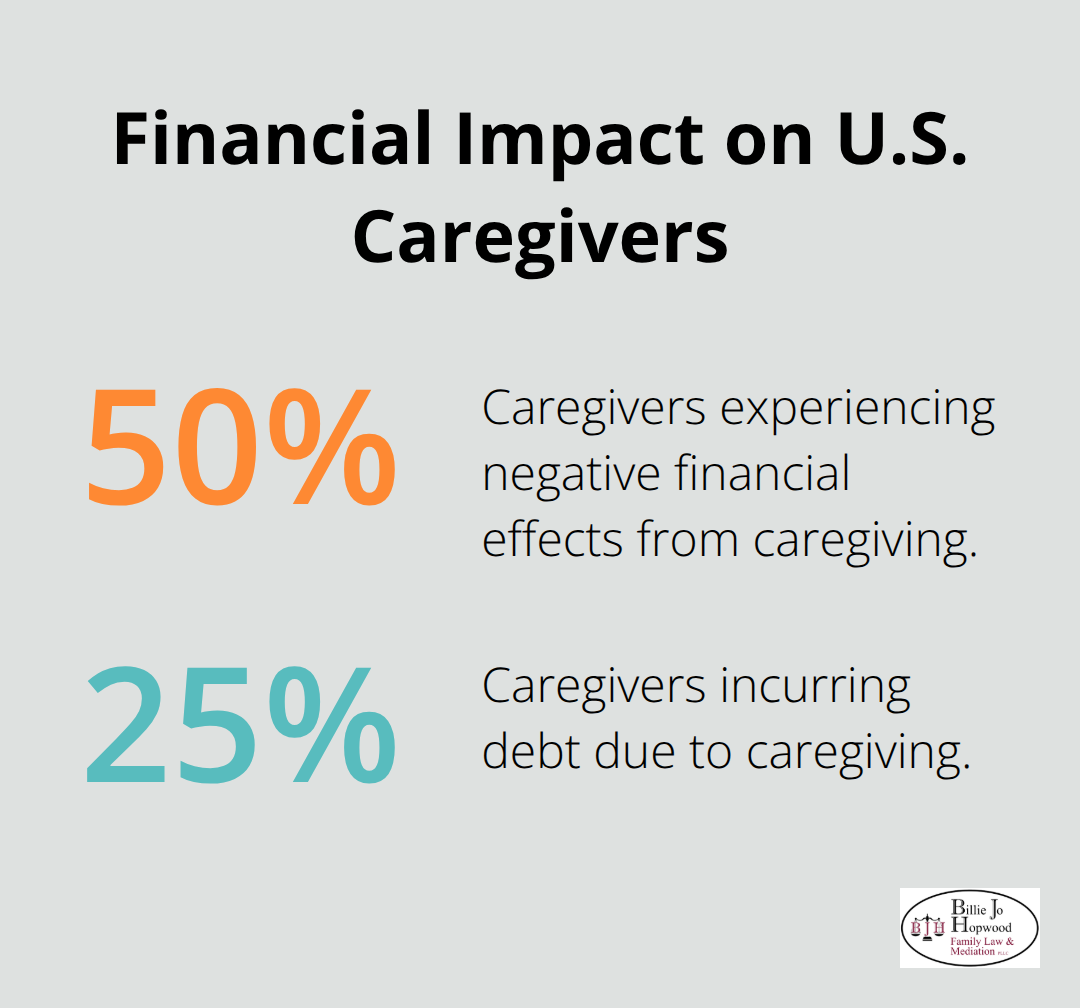
Out-of-pocket expenses for medications, equipment, or care supplies accumulate quickly. Fifty percent of caregivers experience negative financial effects from caregiving, with twenty-five percent incurring debt, according to AARP. Document all caregiving duties, time spent, and any incidents or injuries in writing.

Share of caregivers facing financial strain and debt in the United States - family caregiver legal rights

This documentation serves multiple purposes: it establishes a record if disputes arise, supports potential claims for compensation through Medicaid or state programs, and demonstrates the intensity of your role to insurers or courts. Track every expense and explore reimbursement options through Medicaid programs, tax deductions, or the care recipient’s insurance. A written caregiving agreement clarifying who pays for what prevents financial disputes and protects you from absorbing costs the care recipient can afford. These documented agreements and expense records form the foundation for the next critical step: creating formal legal documents that protect both you and the care recipient.

Protecting Your Role With Written Agreements

Written Caregiving Agreements Establish Clear Expectations

A written caregiving agreement forms the foundation for protecting both your authority and your financial interests. Without one, you operate in legal limbo-responsible for daily care decisions yet lacking the documentation to enforce them. The agreement should specify your caregiving duties in concrete terms: which medications you administer, what medical appointments you attend, whether you manage personal hygiene or mobility assistance, and which household tasks fall under your responsibility. Include the duration of the arrangement, whether it is ongoing or temporary, and what happens if the care recipient’s needs change dramatically.

Compensation and Expense Clarification Prevent Conflict

Address compensation explicitly in your agreement, including whether you receive payment, what amount, how often, and from which source-the care recipient’s personal funds, insurance, Medicaid, or a family member’s contribution. Many caregivers avoid this conversation, assuming it damages relationships, but documented expectations actually prevent resentment and conflict. Specify who covers what expenses: medications, medical equipment, food, utilities, and transportation to appointments. Clarify whether you receive housing, meals, or other in-kind benefits and assign monetary value to them for tax and Medicaid purposes.

Plan for Transitions and Contingencies

State what happens if the care recipient enters a facility, passes away, or the arrangement ends for other reasons. Have an attorney review the agreement before signing to confirm it aligns with state law and protects your interests adequately. This step prevents costly disputes later.

Powers of Attorney Grant Specific Decision-Making Authority

Powers of attorney and healthcare directives handle decision-making authority separately from caregiving agreements. A healthcare power of attorney grants you the legal right to make medical decisions, consent to treatment, and access medical records when the care recipient cannot do so themselves. A financial power of attorney lets you manage bank accounts, pay bills, and handle property matters. These documents require the care recipient to be mentally capable of understanding what they are signing, so execute them sooner rather than later when capacity is clear.

Guardianship Requires Court Involvement and Higher Costs

Many states offer statutory forms through the state bar or attorney general’s office that courts recognize readily. If the care recipient refuses to sign or lacks capacity, guardianship becomes necessary, but courts impose strict requirements and ongoing oversight. Guardianship costs between two thousand and five thousand dollars in attorney fees alone, plus annual court filings and accounting requirements, making it far more expensive and intrusive than preventive documents. If you anticipate guardianship, consult an attorney immediately to explore whether a limited guardianship preserves some of the care recipient’s autonomy while granting you necessary authority, or whether alternatives like healthcare directives or powers of attorney achieve the same practical result. Many families discover too late that a simple document signed years earlier would have eliminated months of court proceedings and family discord. Document your caregiving responsibilities, expenses, and time investment from day one-this record supports potential compensation claims through Medicaid programs, demonstrates the legitimacy of your role if disputes arise, and protects you financially if the arrangement changes unexpectedly.

Final Thoughts

Family caregiver legal rights exist to protect you, but only if you act on them now. Powers of attorney, written caregiving agreements, and documented expenses form a safety net that prevents financial hardship and legal disputes. Most caregivers operate without these protections, discovering gaps only when conflicts arise or circumstances shift unexpectedly.

Taking action prevents costly problems later. Execute a healthcare power of attorney and financial power of attorney while the care recipient has capacity, create a written caregiving agreement that specifies duties and compensation, and document your caregiving time and out-of-pocket costs from day one. Research your state’s paid family leave program, verify insurance coverage for in-home caregiving, and request liability protection through Medicaid if applicable.

At Billie Jo Hopwood Family Law & Mediation, PLLC in Melbourne, Florida, we help families navigate family caregiver legal rights when disputes arise over care authority or when family members disagree about the care recipient’s needs. Contact us to discuss your specific circumstances and explore how formal legal planning protects both you and your loved one.

How to Navigate Family Law Legal Issues Successfully

Family law legal issues affect thousands of families in Melbourne, Florida each year. Whether you’re facing divorce, custody disputes, or support calculations, the decisions you make now shape your family’s future.

At Billie Jo Hopwood Family Law & Mediation, PLLC, we’ve helped countless families find practical solutions through mediation rather than costly court battles. This guide walks you through your options and shows you how to move forward with clarity.

What Family Law Issues Are You Actually Facing in Melbourne, Florida

Divorce Filing Requirements and Timeline

Divorce in Melbourne, Florida requires you to file a petition in Brevard County Circuit Court with your marriage certificate, financial affidavit, and three years of tax returns. Florida law imposes a 6-month waiting period from the date of service, though uncontested divorces without children finalize in 4 to 6 weeks when both parties cooperate. The filing fee costs around $409, but contested divorces with property disputes or custody disagreements stretch 6 to 12 months or longer. Most people assume they must go to trial, but that assumption costs families tens of thousands in unnecessary legal fees and emotional strain.

Why Mediation Resolves More Cases Than Court

Mediation resolves roughly 75% of cases fully or partially before court proceedings begin.

Chart showing that mediation resolves roughly 75% of cases before court proceedings begin. - family law legal issues

When mediation works, you control the outcome instead of allowing a judge to decide for you. The process moves faster and costs far less than litigation, making it the practical choice for families who want to protect their finances and relationships.

Understanding Child Custody and Time-Sharing in Florida

Florida law recognizes two forms of custody: legal custody (which covers major decisions like education and medical care) and physical custody (which determines where your child lives). Courts use the term time-sharing instead of custody, and judges prioritize the child’s best interests by examining emotional bonds with each parent, home stability, school ties, and your willingness to support the other parent’s relationship with the child. No single factor determines the outcome; judges assess the full picture.

Relocation more than 50 miles away requires either the other parent’s consent or court approval through a formal petition. Courts approve relocation when it serves the child’s well-being, such as improving financial stability or providing access to extended family support.

Child Support and Alimony Calculations

Child support calculations follow Florida guidelines based on both parents’ income, the number of overnight stays, and childcare costs. Parents can negotiate amounts that fit their actual finances through mediation rather than accepting rigid guideline amounts. Alimony awards depend on factors like marriage length, each spouse’s earning capacity, and standard of living during the marriage, with durational alimony common for shorter marriages and permanent alimony rare for marriages under 17 years.

Preparing Documents Before Mediation or Court

The Brevard County Court requires parenting classes under Florida Statute §61.21(4) for all cases involving children (budget roughly $150 to $300 for that course). Most families benefit from preparing a detailed parenting plan and gathering financial documents before any mediation session, as this preparation directly influences how quickly disputes resolve and whether agreements actually stick long-term. With your documents organized and your priorities clear, you’re ready to explore how mediation actually works and why it produces better outcomes than courtroom battles.

Why Mediation Works Better Than Fighting in Court

Control Over Your Family’s Future

Mediation puts you in control of your family’s outcome instead of handing that power to a judge who knows nothing about your situation. In litigation, a judge makes binding decisions after a single hearing, often based on incomplete information or arguments your attorney couldn’t fully develop due to time constraints. Mediation works differently: you and the other party sit with a neutral third party who helps you communicate directly about what matters most. The mediator doesn’t decide for you; instead, they help you find solutions that both parties can live with long-term. This distinction matters enormously because agreements you reach together tend to stick, whereas court orders often breed resentment and lead to enforcement battles down the road.

The Financial Reality of Mediation vs. Litigation

Mediation typically costs significantly less than litigation while moving faster-contested litigation in Brevard County routinely exceeds $15,000 to $30,000 when attorney fees, court costs, and custody evaluations (which run $1,500 to $6,000) are factored in. Cases resolve in hours or a single day through mediation compared to 6 to 12 months or longer in court. Most importantly, mediation achieves full or partial agreement in roughly 75% of cases before court proceedings ever begin. When you sit across the table with the other party and a trained mediator, you hear their actual concerns rather than filtered versions through competing attorneys. You can propose creative solutions-flexible custody schedules, adjusted support amounts that reflect your real finances, or property divisions that work for both households-without waiting months for court availability.

Even when mediation doesn’t produce complete agreement, it clarifies each party’s positions and strengthens your trial strategy if litigation becomes necessary. You’ve already identified which issues are negotiable and which ones require a judge’s decision, saving enormous time and expense later.

Preparing Your Documents and Mindset

Preparing effectively for mediation means gathering your financial documents now and thinking clearly about your priorities before you sit down with the mediator. Bring recent pay stubs, three years of tax returns, bank statements, and a detailed list of assets and debts so discussions stay grounded in reality rather than speculation. If children are involved, prepare a proposed parenting plan that addresses school schedules, holiday arrangements, and decision-making authority. Courts in Brevard County expect this documentation anyway, so completing it early accelerates resolution whether through mediation or later litigation.

Approach mediation with genuine openness to solving problems rather than winning against the other party; families who adopt a collaborative mindset reach agreements that protect everyone’s interests, especially the children. Try scheduling sessions at times that work for your life and conducting them via video conferencing with private breakout rooms if in-person meetings feel uncomfortable. You control the pace, the location, and whether you bring an attorney to advise you during breaks. This flexibility transforms mediation from an intimidating process into a practical tool for moving your family forward and sets the stage for understanding what happens when you actually sit down at the mediation table.

Get Your Documents and Mindset Ready

Organize Your Financial Records Now

Florida courts require a financial affidavit (Form 12.902(b) or 12.902(c)), recent pay stubs, three years of tax returns, bank statements showing assets and debts, and your marriage certificate. If children are involved, add birth certificates, current school and medical records, and a proposed parenting plan detailing custody schedules, holiday arrangements, and decision-making authority. The Brevard County Court expects these documents regardless of whether you mediate or litigate, so preparing them now saves weeks of delays later.

Most people underestimate how much time document collection takes-budget at least two weeks to gather everything, especially tax returns and bank statements from multiple years. Organize documents in a binder with clear tabs so you can reference them quickly during mediation sessions or court hearings. When you arrive prepared, mediators and judges take you seriously, and the other party realizes you’re committed to resolving this efficiently.

Complete Required Parenting Classes Early

Courts under Florida Statute §61.21(4) require you to complete a parenting course costing roughly $150 to $300 before proceeding with any case involving children. Complete this requirement early so it never becomes a scheduling obstacle later. This course addresses co-parenting strategies and child development, helping you demonstrate to the mediator or judge that you understand your responsibilities as a parent moving forward.

Adopt a Problem-Solving Mindset

Families who approach mediation as problem-solving rather than warfare reach agreements that stick long-term, whereas those seeking victory often spend $20,000 to $40,000 in attorney fees and still feel dissatisfied. Accept that the other party won’t agree on everything, and that’s fine; mediation succeeds when both sides get their essential needs met, not when one side wins completely.

If emotions run high during preparation, consider scheduling mediation sessions via video conferencing with private breakout rooms, which many families find less confrontational than sitting across a table. Bring an attorney to mediation if you have one, or consult with one beforehand to understand your legal position so you negotiate from knowledge rather than fear. The combination of organized documents and realistic expectations transforms mediation into the fastest, cheapest path to moving your family forward.

Final Thoughts

Family law legal issues demand clear thinking and practical action. Mediation resolves roughly 75% of cases before court proceedings begin, costs far less than litigation, and puts you in control of outcomes that affect your family for years to come. Contested litigation in Brevard County routinely costs $15,000 to $30,000 when attorney fees, court costs, and custody evaluations are factored in, while mediation moves faster and achieves resolution in hours or a single day.

Agreements you reach together tend to stick long-term, whereas court orders often breed resentment and enforcement conflicts down the road. You’ve learned that organizing your financial documents, completing required parenting classes, and approaching mediation with genuine openness to solving problems transforms the process from intimidating to manageable. The path forward isn’t complicated-it requires action today rather than waiting for problems to escalate into expensive court battles tomorrow.

Contact Billie Jo Hopwood Family Law & Mediation, PLLC at 321-426-1840 to schedule a free initial consultation and explore mediation as a practical alternative to litigation. Bring your questions, your organized documents, and your willingness to move forward with confidence. We help families in Melbourne, Florida navigate divorce, child custody, alimony, and child support through mediation that protects everyone’s interests, especially your children.

How to Understand Family Law Legal Fees

Family law legal fees can feel overwhelming when you’re facing a divorce, custody dispute, or mediation. Most people don’t understand how attorneys charge or what costs to expect.

We at Billie Jo Hopwood Family Law & Mediation, PLLC know that transparent pricing matters. This guide breaks down fee structures, common expenses, and practical ways to keep costs manageable.

How Family Law Attorneys Charge for Your Case

Hourly Billing: The Traditional Model

Family law attorneys most commonly charge by the hour, with rates typically ranging from $150 to $500 per hour depending on experience and location. You pay for every minute an attorney spends on your case, which creates real uncertainty about your final bill. This model works reasonably well for straightforward matters like uncontested divorces with minimal assets, but contested custody disputes or complex asset divisions often spiral into unpredictable expenses.

The fundamental problem with hourly billing is that it rewards longer work rather than efficient resolution. An attorney billing hourly has no financial incentive to settle quickly or work efficiently. About 50 percent of law firms now offer flat fee options, a clear signal that clients want cost predictability upfront instead of this uncertainty.

Flat Fee Arrangements: Knowing Your Total Cost

Flat fee arrangements charge one fixed price for a specific service or phase of your case, making budgeting straightforward and eliminating surprises. A simple divorce with no children might cost $2,500 to $4,000 flat, while a contested custody dispute could run $5,000 to $8,000 depending on complexity. Flat fees work best when the scope is clearly defined-both you and your attorney must agree exactly what’s included and what triggers additional charges.

Flat fees work particularly well for document preparation and uncontested filings, where the work is predictable and standardized. Technology-driven automation makes many routine family law tasks more standardized, enabling transparent flat-fee arrangements that benefit both clients and firms.

Retainer Agreements: A Hybrid Approach

Retainer agreements sit between hourly and flat fee models. You pay an upfront sum (often $1,500 to $5,000) that the attorney bills against as they work, with invoices showing how much of your retainer remains. If your case costs more than the retainer, you pay the overage; if it costs less, you may receive a refund.

This structure provides some cost predictability while allowing flexibility for cases that develop unexpectedly. Many attorneys prefer retainers because they establish a financial commitment from the client and improve cash flow for the firm.

Choosing the Right Fee Structure for Your Situation

The strongest move is asking your attorney to offer a menu of options rather than forcing you into one model. Flat fees work well for straightforward matters, while hourly or capped billing makes sense for high-conflict cases where unpredictable issues arise. Getting a clear written estimate upfront-including what’s included, what costs extra, and how many sessions or hours you can expect-prevents the financial chaos that derails many families.

Discuss these structures before your first meeting so you understand exactly what you’re paying for. Beyond attorney fees, however, you’ll encounter other costs that vary significantly based on your specific situation.

Beyond Attorney Fees: What Else You’ll Pay

Court Costs Add Up Quickly

Court filing fees, evaluation costs, and mediation expenses accumulate fast once your case moves forward. Florida divorce filing fees run $408 to $603 depending on the county, and that’s just the initial paperwork. You’ll also pay service of process fees to notify your spouse, typically $50 to $200. If your case involves child custody disputes, the court may order a custody evaluation by a mental health professional, which costs $1,500 to $5,000 and comes out of your pocket before trial even starts.

Key Florida family court costs at a glance - family law legal fees

These hidden expenses blindside families who only budgeted for attorney fees, leaving them scrambling to find money mid-case.

Mediation Costs Far Less Than Litigation

Private mediation typically costs between $3,000 and $8,000 total, with attorney-mediators charging $250 to $500 per hour and nonattorney mediators ranging from $100 to $350 per hour depending on credentials and location. If you split the fee 50-50 with your spouse, your share drops significantly. Flat-rate mediation packages commonly range from $4,000 to $5,500 and may include unlimited hours or a capped number of sessions, though you should verify what’s included-some packages cover settlement drafts while others don’t.

Court-sponsored mediation costs far less or nothing at all. Florida’s court-ordered mediation charges $120 to $240 per session, or $60 to $120 per spouse if combined income falls under $100,000, making it accessible for families with limited resources. The real advantage of mediation is predictability: you know upfront what you’ll pay, whereas litigation spirals unpredictably as discovery drags on and hearings multiply.

Preparation Determines Your Final Bill

A spouse’s preparation and willingness to compromise dramatically affect mediation length and cost. Arriving with organized financial documents and clear priorities can settle a case in two to three sessions rather than stretching it across months. You control this variable directly-the work you do before mediation sessions begins translates into lower fees and faster resolution. This cost control starts with choosing the right process, not just the right attorney, which brings us to the practical strategies that reduce your overall expenses.

Ways to Reduce Your Family Law Legal Expenses

Mediation Costs Far Less Than Litigation

Mediation stops the financial bleeding that litigation causes. When you litigate, your attorney bills for discovery requests, depositions, motions, court appearances, and endless back-and-forth communication that stretches across months or years. Private mediation costs between $3,000 and $8,000 total, with attorney-mediators charging $250 to $500 per hour and nonattorney mediators ranging from $100 to $350 per hour. Split that fee 50-50 with your spouse, and your personal cost drops dramatically compared to litigation, where each side’s attorney fees accumulate independently. Flat-rate mediation packages commonly range from $4,000 to $5,500 and may include unlimited hours or a capped number of sessions, giving you genuine cost certainty before your first session. Court-sponsored mediation costs even less-Florida’s court-ordered mediation charges $120 to $240 per session, or $60 to $120 per spouse if combined income falls under $100,000. Most cases settle in two to three sessions, whereas contested litigation often stretches across multiple years with custody evaluations ($1,500 to $5,000), expert witnesses, and trial preparation adding thousands more. Mediation also eliminates the emotional escalation that drives up litigation costs; when both parties remain calm and focused on interests rather than positions, the process moves faster and cheaper.

Organize Your Documents Before You Meet Your Attorney

Your preparation directly controls what you pay. Attorneys bill for time spent organizing your financial documents, searching for bank statements you should have collected, and clarifying information you could have provided upfront. Arrive at mediation or your attorney’s office with financial disclosures organized by category-bank accounts, retirement accounts, real estate, debts, income sources-and you eliminate hours of billable work. A simple spreadsheet listing all assets with approximate values and ownership percentages can reduce mediation sessions from five to two. If child custody is at issue, prepare a detailed parenting proposal that addresses school schedules, healthcare decisions, and holiday arrangements before your first meeting. This preparation prevents attorneys from charging you to draft what you could have outlined yourself. Technology makes this easier than ever; convert images of documents to PDFs, organize files by year and category, and create a shared folder your attorney can access directly. This approach cuts administrative time and reduces the back-and-forth communication that inflates bills. Gather twelve months of bank and credit card statements before your first consultation. Many families waste hundreds in attorney time because they schedule meetings before collecting basic financial information.

Establish Fee Terms at Your Initial Consultation

Discussing fees at the start of your relationship with an attorney prevents the shock of a bloated bill later. Ask your attorney to provide a written estimate that specifies the retainer amount, what’s included in that retainer, what hourly rate applies to any overage, and what additional costs might emerge. Request clarity on communication costs-some firms charge for email responses while others bundle communication into their standard rate. Ask specifically whether your flat fee covers settlement drafting or whether that triggers extra charges. This conversation should happen during your initial consultation, not weeks into the process when you’ve already accumulated hours. Get everything in writing, not as a verbal promise. If your attorney resists providing a written fee agreement, that’s a warning sign about their approach to transparency. Many attorneys reserve five to ten minutes at the end of the initial consultation specifically to review the legal services agreement and answer fee questions. Take that time seriously and ask for clarification on any term you don’t understand. If your case is complex, ask about milestone-based fees tied to case phases-initiation, discovery, negotiation, final decree-rather than open-ended hourly billing. This structure aligns your attorney’s financial incentive with efficient resolution rather than prolonging the process.

Final Thoughts

Family law legal fees don’t have to derail your finances when you understand your options and take control of the process. Hourly billing creates uncertainty for complex cases, flat fees provide the cost predictability most families want, and retainers offer flexibility when your situation might shift unexpectedly. The single most important step is establishing fee terms at your initial consultation with a written estimate that specifies retainer amounts, hourly rates, what’s included, and what triggers additional charges.

Your preparation directly controls your final bill more than any other factor. Organized financial documents, clear priorities, and a detailed parenting proposal eliminate hours of billable work and can reduce mediation sessions from five to two. Mediation typically costs between $3,000 and $8,000 total-far less than litigation, which spirals across months or years with mounting attorney bills and court costs ($1,500 to $5,000 for custody evaluations alone).

We at Billie Jo Hopwood Family Law & Mediation, PLLC understand that family law matters demand both compassionate guidance and financial clarity. Contact us to discuss how mediation can protect your family’s financial future while resolving your legal matter efficiently.

Legal Issues in Family Business: What You Need to Know

Family businesses face unique legal challenges that can threaten both relationships and financial stability. Ownership disputes, succession planning failures, and tax complications destroy countless family enterprises every year.

We at Billie Jo Hopwood Family Law & Mediation, PLLC help families navigate these legal issues in family business before they spiral into costly conflicts. This guide covers the strategies you need to protect your business and your family.

Ownership and Succession Planning in Family Businesses

Ownership Disputes Destroy Family Enterprises

Ownership disputes destroy family businesses faster than poor market conditions. Only 30% of family businesses survive to the second generation, according to research on family business succession, and the primary culprit is unclear ownership structures and nonexistent succession plans. Most family business owners operate with handshake agreements and informal promises instead of written documentation, which guarantees conflict when the founder steps back or passes away. You need a written ownership structure that spells out who owns what percentage, how ownership transfers happen, and what happens if a family member wants to leave the business.

30% of family businesses survive to the second generation - legal issues in family business

How Minnesota LLC Law Affects Your Business Value

Minnesota LLC law permits member transfers to convey only economic rights unless other members consent to management participation, creating what valuators call a lack-of-control discount that can reduce your business worth by 20% to 40%. This structural vulnerability exposes your family to significant financial loss during transitions or disputes. A buy-sell agreement locks in pricing methodology, identifies who can purchase shares, and specifies payment terms, preventing costly litigation over valuation when emotions run highest. Without one, siblings fight over business value while the business itself deteriorates, customers leave, and employees jump ship.

Funding Your Buyout Strategy

The agreement should address what triggers a buyout (death, disability, divorce, retirement) and whether the business, remaining owners, or a third party funds the purchase. Life insurance held in an irrevocable life insurance trust provides liquidity without tax complications, ensuring funds exist when you need them most. This approach protects both the business and family members who depend on the buyout proceeds.

Naming Your Successor and Building the Transition

Succession planning requires naming your successor at least five years before transition and documenting the plan in writing. Nearly half of family business owners nearing retirement have not named a successor, according to succession planning research, leaving the business rudderless during critical transitions. Your plan should specify the successor’s responsibilities, a timeline for gradual leadership handoff, and mentorship structures that build the next leader’s credibility with employees and customers.

Coordinating Estate Planning with Business Ownership

Estate planning must coordinate with your business plan; if you own the business outright, your will or revocable trust should transfer ownership to the intended successor and specify how other family members receive equivalent value through insurance proceeds or other assets. Without coordination, one child inherits the business while others inherit nothing, triggering resentment and oppression claims. Document all agreements in a formal operating agreement or shareholders agreement that family members sign before disputes emerge. This agreement should cover voting rights, decision-making authority, distributions, and what happens if someone wants out. The cost of drafting these documents is negligible compared to litigation expenses, which routinely exceed six figures in family business disputes.

These ownership and succession structures form the foundation for stable family businesses, but they only work when family members also establish clear roles and decision-making processes that separate personal relationships from business operations.

Management and Decision-Making Conflicts

Separate Professional Authority from Family Bonds

Family members working together blur the line between personal loyalty and professional accountability, creating decision-making paralysis that damages the business. A sibling might hesitate to fire an underperforming brother-in-law, or a parent might override sound business decisions to protect a child’s feelings. This emotional entanglement prevents companies from making the tough calls that keep operations competitive. You need documented job titles, written responsibilities, and decision-making authority that exist independent of family relationships. When someone holds the title of Chief Financial Officer, their authority over accounting and budgeting decisions should be identical whether they are your son or a stranger you hired from outside.

Create Clear Organizational Structure

Create an organizational chart that shows reporting lines and decision rights for every position, then enforce it consistently. If your daughter manages the sales team, she has authority over hiring, firing, and performance management decisions within that department. If your spouse serves as operations manager, they make scheduling and resource allocation choices without consulting you on every detail. This separation prevents family members from second-guessing professional decisions and allows the business to operate with the speed and discipline that competitors demand.

Establish a Formal Conflict Resolution Process

Disagreements over business direction, compensation, and resource allocation will happen regardless of how well you document roles. The difference between businesses that survive and those that implode is having a conflict resolution process before emotions take over. Most family businesses lack any formal mechanism to resolve disputes, so arguments fester and relationships deteriorate. Establish a family business council that meets quarterly to discuss operations, strategy, and any concerns. Include only active family members who work in the business, not passive investors or spouses who lack operational involvement.

Key steps to formalize conflict resolution in a family business - legal issues in family business

Use Neutral Facilitation for High-Tension Disputes

Hire a neutral third party to facilitate these meetings if family tensions run high. Set ground rules for these meetings: no personal attacks, focus on business facts and financial data, and all decisions require documentation in writing. If a major disagreement emerges that the council cannot resolve, commit to mediation before escalating to litigation. Litigation destroys family businesses far faster than the underlying dispute ever could. A business facing a lawsuit between owners loses employee focus, customer confidence, and operational momentum while legal bills mount. Mediation costs a fraction of litigation and allows family members to preserve relationships while finding practical compromises that keep the business operating.

These decision-making structures and conflict resolution processes protect your business from internal collapse, but they only function effectively when family members also understand the financial realities that shape business sustainability and tax obligations.

Financial and Tax Considerations for Family Businesses

Family business owners often treat taxes as an afterthought, then panic when the IRS sends notices or when a sale triggers unexpected liabilities. Your business structure directly determines how much you pay in taxes and how much you keep when you exit.

Choose the Right Business Structure for Tax Savings

An S-Corporation saves you self-employment taxes on distributions, while an LLC taxed as a partnership shields you from double taxation that C-Corporations face. The wrong choice costs tens of thousands annually. If you operate as a sole proprietor or general partnership, you pay self-employment taxes on all business income, even profits you reinvest in growth. Switch to an S-Corp and you pay self-employment taxes only on reasonable salary, then take the remaining profits as distributions free from those taxes. For a family business generating $200,000 in annual profit, this structure shift saves roughly $15,000 per year in self-employment taxes alone. Coordinate this decision with your accountant and attorney before you establish the business, because restructuring later triggers unexpected tax bills and state filing fees.

Share Financial Data With All Family Members

Financial transparency prevents the disputes that destroy family businesses faster than market downturns. When one family member controls bank accounts and financial data while others work in the business, resentment builds and accusations of theft or mismanagement surface inevitably. Institute monthly financial reports that show revenue, expenses, owner distributions, and cash position, then share these reports with all family members involved in operations. If someone questions a large expense or unusual transaction, they can ask questions while emotions remain calm rather than discovering problems during a crisis or exit.

Document All Family Loans in Writing

Document all loans between the family and the business with written promissory notes that specify interest rates and repayment terms, because the IRS disallows interest-free family loans and treats them as gifts or hidden income. This protection shields your family from unexpected tax assessments and audit complications.

Plan for Estate Taxes Before They Arrive

When you pass the business to the next generation, estate taxes can consume 40% of the business value unless you plan ahead. Fund a life insurance policy with death benefits sufficient to cover the estate tax bill, held in an irrevocable life insurance trust so proceeds avoid both income and estate taxation. This approach ensures your heirs receive the business without forced fire-sales to pay tax obligations. Work with a tax professional and attorney experienced in family business transitions to align your ownership structure, compensation strategy, and estate plan into a cohesive system that minimizes taxes and maximizes what your family actually receives when you retire or pass away.

Estate taxes can consume 40% of a business without planning

Final Thoughts

Family business owners who postpone legal planning until disputes emerge pay a devastating price in litigation costs, business collapse, and family estrangement. The strategies outlined in this guide-written ownership structures, clear succession plans, documented decision-making authority, and coordinated tax planning-cost far less than the legal issues in family business that destroy enterprises when owners fail to act. These protections work only when you implement them before conflict surfaces, not after relationships deteriorate and positions harden.

Start by reviewing your current operating agreement, buy-sell arrangement, and succession plan with your accountant and attorney to verify your business structure minimizes taxes and all agreements are legally sound. If these documents don’t exist or haven’t been updated in five years, they no longer reflect your business reality or family circumstances. Document every loan between family members and the business, share monthly financial reports with active family members, and establish a quarterly family business council meeting to discuss operations and resolve disagreements before they escalate.

If family tensions already exist or you anticipate conflict during a transition, mediation offers a path forward that preserves relationships while protecting the business. Billie Jo Hopwood Family Law & Mediation, PLLC in Melbourne, Florida understands how family dynamics complicate business decisions and legal planning, and we help families work through disagreements and develop practical solutions that keep operations stable while honoring family values.

How to Organize Essential Family Legal Documents

Most people keep family legal documents scattered across drawers, filing cabinets, and email folders. When a medical emergency or legal matter strikes, finding the right paperwork becomes a nightmare.

We at Billie Jo Hopwood Family Law & Mediation, PLLC see firsthand how disorganized documents create unnecessary stress and delays. A simple system now prevents chaos later.

Why Organization Matters in Family Law

Court Expectations and Case Resolution

When divorce or custody matters land in court, judges and mediators expect documentation that proves your claims. Disorganized records-missing bank statements, unclear asset lists, or undated agreements-weaken your position immediately. Florida courts handle roughly 3.4 divorces per 1,000 residents annually, and attorneys across the state report that clients who arrive with organized financial records resolve cases 30 to 40 percent faster than those scrambling to locate paperwork during proceedings. The American Bar Association emphasizes that organized documents reduce legal fees by cutting the time attorneys spend hunting for information rather than building your case.

Chart showing faster case resolution with organized financial records in Florida family law cases

Mediation and Settlement Success

In family law mediation, which Florida requires before trial in most divorce cases, having your documents prepared signals you’re serious about reaching a fair agreement quickly. Courts view disorganization as a red flag-it suggests either carelessness with finances or an attempt to hide information. Neither impression helps your position. Organized records demonstrate transparency and allow mediators to focus on substantive issues rather than chasing down missing paperwork.

Protecting Your Family When Emergencies Strike

Beyond the courtroom, emergencies don’t wait for preparation. A sudden hospitalization, death in the family, or urgent custody decision can occur without warning. If your spouse or a family member cannot locate your healthcare directive, power of attorney, or guardianship documents, hospitals and courts will move forward without your stated preferences. The National Funeral Directors Association notes that families without clear end-of-life documentation face both emotional trauma and financial complications when making urgent decisions.

Safeguarding Your Children’s Financial Future

Your children’s financial security depends on current beneficiary designations on retirement accounts and life insurance policies-outdated paperwork means your assets may pass to an ex-spouse or former guardian instead of your intended heirs. Organization protects your family’s interests when you cannot advocate for yourself. Treating document organization as an ongoing responsibility (not a one-time task completed before a legal matter arises) keeps your family’s protection current as circumstances change.

The next section walks through which specific documents demand your immediate attention and where to store them safely.

What Documents You Actually Need to Keep

Wills, Trusts, and Powers of Attorney

Your will, trust, and powers of attorney control what happens to your assets and who makes decisions if you cannot act. Your will dictates where your property goes after death; your trust allows you to avoid probate and protect assets during your lifetime; your durable power of attorney for finances lets someone manage your accounts if illness or injury prevents you from doing so. The American Bar Association recommends keeping original signed copies in a fireproof safe at home and copies in a separate secure location like a bank safety deposit box. Courts require original signatures for probate and healthcare decisions, so do not store these only digitally.

Update your will and powers of attorney after major life changes: divorce, remarriage, the birth of children, or significant changes in your financial situation. Many people make the mistake of keeping outdated documents that name an ex-spouse as executor or healthcare agent, which creates legal chaos when that person no longer represents your wishes.

List of key life events that require updating wills and powers of attorney - family legal documents

Identity and Family Relationship Documents

Marriage certificates, birth certificates, and adoption papers form the foundation of your family’s legal identity. These documents prove relationships that courts rely on for custody decisions, inheritance claims, and Social Security benefits. Adoption papers specifically matter in family law because they establish parental rights and affect inheritance and guardianship if something happens to you.

Keep originals in your fireproof safe and request certified copies from your state’s vital records office (these cost between fifteen and fifty dollars and carry legal weight that photocopies do not). Certified copies serve as proof in court proceedings and government applications where standard photocopies fail.

Property and Financial Records

Property deeds, mortgage documents, and recent financial statements require the same protection because they establish ownership and current asset values. Your deed proves you own the home; your mortgage statement shows what you owe; your bank statements from the last three to six months demonstrate liquid assets available for division in mediation or court.

Outdated financial statements create disputes during property division-use current statements dated within ninety days whenever possible. The Internal Revenue Service recommends keeping tax returns and supporting documents for at least seven years, which covers the statute of limitations for audits and provides proof of income for child support and alimony calculations in Florida family law matters.

With these core documents identified and stored, the next step involves choosing the right storage methods to protect them from loss, damage, or unauthorized access.

Storing Documents Where They Stay Safe and Accessible

Physical Storage: Safes and Safety Deposit Boxes

A fireproof safe bolted to your home’s floor or wall costs between two hundred and eight hundred dollars and protects documents from fire, theft, and water damage. The American Bar Association recommends keeping original signed wills, powers of attorney, and healthcare directives in this safe because courts require originals for probate and medical decisions. A bank safety deposit box costs between thirty and three hundred dollars annually and provides a second secure location for copies of critical documents. The combination approach works best: originals at home in the safe where you can access them quickly if needed, certified copies in the safety deposit box as a backup if your home becomes inaccessible. Never store documents only digitally or only in one location, as house fires, floods, and break-ins happen without warning and losing your only copy of a will or deed creates expensive legal problems for your family.

Digital Backups and Cloud Security

High-quality digital scans of every document protect your records against physical loss. A scanner or smartphone app captures clear, legible images that you can store on a trusted cloud service like Google Drive or Dropbox. The Federal Bureau of Investigation’s Internet Crime Complaint Center recommends maintaining an offline backup on an external hard drive stored in a separate location from your home.

Checklist of best practices for securing digital document backups - family legal documents

Two-factor authentication on cloud accounts and a password manager control access effectively. Restrict access to a small number of trustworthy people, and review who has access at least once yearly to prevent unauthorized viewing of sensitive information.

Creating Your Master Inventory

A simple one-page master inventory lists where each document lives: which documents are in your fireproof safe, which copies are in your safety deposit box, and where digital backups are stored. Include contact information for your bank, attorney, and the person you’ve designated to access these documents in emergencies. This inventory itself should live in multiple places so whoever needs these documents during a crisis can find them without calling around frantically.

Final Thoughts

Start organizing your family legal documents this weekend. Gather everything scattered across your home: wills, trusts, powers of attorney, birth certificates, property deeds, and financial records from the last three to six months. A fireproof safe at home and a bank safety deposit box protect originals and copies, while digital scans backed up offline ensure nothing disappears in a crisis.

The payoff arrives immediately when a legal matter surfaces. You walk into mediation or court with organized records that strengthen your position and reduce attorney fees by cutting research time. Your children’s financial security stays protected because beneficiary designations remain current, and your healthcare wishes get honored because your directive sits where hospitals can find it.

If you’re facing a family law situation in Melbourne, Florida, and need guidance on organizing your family legal documents or preparing for mediation, reach out to our firm. Taking action now costs nothing except time, while waiting until a divorce or custody battle forces you to scramble costs thousands in legal fees and emotional stress.